For this week's spiritual thought, I've decided to touch on current events and present this urgent call to repentance. This post is written in terms that my Latter-day Saint friends will understand, but what I say here applies to all Christians equally.
During these uncertain times, tensions and anger have risen to dangerously high levels. Never before have I seen so much entrenchment, hatred, and even violence. Members of the two major parties see each other as enemies like never before. In particular, we appear to have disagreements over who has won the last national election to such a degree that violence erupted last week, and will, with near certainty, erupt this coming week.
So alarming has this trend been that the prophets of my church (Church of Jesus Christ of Latter-day Saints) have warned us and given us council on several occasions. In June 2020, President Nelson condemned the "looting, defacing, or destroying public or private property."
During the October 2020 General Conference, practically all talks touched on current events and the rising hatred. Several times we were reminded to "Love Your Enemies." In particular, Pres. Oaks gave a whole talk just on that subject alone. Here's a summary.
In November 2020, President Nelson launched the week-long #givethanks campaign. He suggested that the best way to navigate through our current hard times is to have a thankful heart. I think the effort did help somewhat, and there's no reason not to continue.
Just this past week, the church has issued yet another statement urging against violence and to honor democratic institutions and processes.
In addition, the Church puts out its usually periodic statements about political neutrality and the importance of voting. Here is the latest statement. If you check earlier years, you'll see these statements always contain variants of the following council:
Principles compatible with the gospel may be found in various political parties, and members should seek candidates who best embody those principles.
While the Church affirms its institutional neutrality regarding political parties and candidates, individual members should participate in the political process. Please strive to live the gospel in your own life by demonstrating Christlike love and civility in political discourse.
I believe the instructions from our Church leaders are clear. There is no official Church party. In each party, principles can be found that are compatible with the gospel. And, we should always be demonstrating Christlike love, including civility in our political discourse.
And they have said it not once, but several times over the past. I believe they are very concerned over us and want us to do the right thing. Also, I would bet that my Christian friends from other denominations are receiving similar council, except for a few more militant churches.
Also, note that these leaders mention that we "should participate in the political process." And they are not asking us to refrain from protesting peacefully. They're just asking us to be respectful toward each other, refrain from violence, and remember Christlike love and civility. Indeed, I have had several productive conversations with "opponents" over the last few months. We don't always succeed in convincing the other person, but I think we end up having a better understanding of the opposing view.
Yet, I am distressed to see so many self-proclaimed Christians (not just members of my church) choosing to ignore this council. I see posts comparing one candidate to God and another to Satan, and posts saying "If you believe this, there's no way we can be friends." I see plenty of angry ad hominems lobbed at other people. There are even plenty of posts along the lines of, "If you voted for this person, you're going to have trouble at the pearly gates."
If you need any proof or reminder of this, I invite you to check out the latest announcement by the Church on their Facebook page, and peruse the comments. And then you will see what I mean. It is a very sad irony that the prophets call for peace, love, respect, and understanding, and the majority of responses are just the opposite.
On the one side, Trump is lifted up as God's chosen -- like an idol, someone who can do no wrong, and who is believed beyond all other considerations ... a devotion I've never before witnessed. Not Reagan, not Clinton, and not even Obama.
And evidently ... not even President Russell M. Nelson. People would rather set aside this warning and council in defense of their man. Anyone speaking against Trump is a heretic worthy of hellfire.
On the other side, Trump is a symbol of hate and evil. He can do no right. Even Republicans who helped Trump get into power are complicit and need to be removed from office. I've even had one friend on Facebook post: "If you are a member of the Republican Party, then this is all your fault. You can defriend me."
I believe the truth is somewhere in the middle: Trump is not all good, but he's also not all bad. That's why we should try much harder to understand our opponents (not "enemies"). We don't need to agree, but understanding can go a long way, and beneficial answers can be found to help everyone.
But from what I'm witnessing, this is not happening right now. It's why I ask in the title: where have all the Christians gone? Because, in all honesty, I don't see very many right now.
I should probably mention that in my most immediate area, by far, most of my church friends are being quite reasonable -- I think we have a great ward. They are also not posting that much on social media -- so I'm pretty sure that what I see is really a minority of "loud" disgruntled Christians who are posting and not being very Christian.
Most urgently, though, I want you to consider this. It doesn't take a prophet to guess what's going to happen in the next few days. Thousands of armed troops will be protecting Washington DC. Who knows how many people will come to participate in armed protests? You know that these two will not mix very well. There is going to be death ... somewhere. And I'm not certain how many peaceful protestors may be caught in the middle.
I get that many of you are passionate in what you believe. You feel that you need to do something about it. Perhaps you wish to stop the transfer of power. Or perhaps you're planning on staging a counter protest. Either way, just make sure not to be this dog ...

You may find yourself in a sudden situation where you cannot avoid losing your life. And then it's too late.
Or ... you can choose to listen to the prophets now ... remember who you are ... bring out the Christlike love ... turn on the spirit of gratitude ... love your enemies ... and live to discuss these matters another day.
I believe we can get through this and persevere... as long as we act like Christians.
I debated what topic to pursue this week. I know I don't want to concentrate on Church history every single week, but then again, this week's lesson is a big one. It's also a very divisive topic -- just to warn you off the bat. But I ultimately decided, I can take this opportunity to showcase this core belief in my church for your education. If anyone ever wants to learn about the "Mormons," this is one of the most important stories to learn, because this is the origin story of the Church.
Here's the short version of the story, usually called "The First Vision," but you can learn much more by reading Joseph's account here.
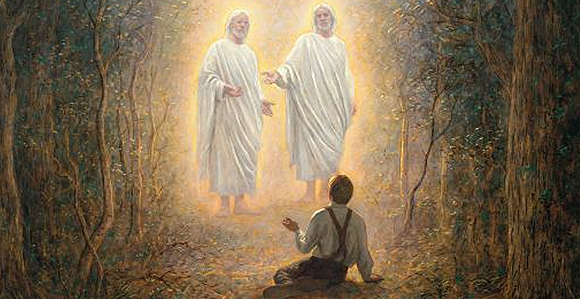
In 1820, Joseph Smith, 14 years old, went out to the woods behind his farm to pray. He wanted to ask which church to join. He was then visited by God and Jesus who told him to join none of the churches. They would subsequently help Joseph to restore the original Church of Jesus Christ -- hence the full name of our church: The Church of Jesus Christ of Latter-day Saints.
Joseph Smith goes into much more detail ... what God and Jesus looked like, what they said, the scriptures they quoted, what prophecies they uttered, and what instruction they gave.
When I tell this story to most people, it is almost always met with skepticism. "Do you actually believe this?" Some may just say, "Interesting" and nod their heads, but you can still see it in their eyes.
It's because it's a remarkable story -- just like a burning bush talking to Moses, or Jacob wrestling with God, or Jesus healing the sick. And it's a story that's impossible to prove. Was anybody else in the woods to corroborate the story? No. We can only rely on the words of Joseph Smith, himself.
Can one be a member of the Church of Jesus Christ of Latter-day Saints and not believe this story? Not really, because the whole Church hinges on this genesis story. If Joseph did not see God and Jesus, then everything else couldn't have happened ... the instruction, the prophecies, the Book of Mormon. In other words, as many people in the world believe, Joseph Smith simply made it all up. On the other hand, if the story is true, then everything else is true, and it would become imperative to investigate this religion.
And thus comes the source of division.
Indeed, I have no way to prove the story. I can only believe it in faith.
In 2019, I took my family to Palmyra, NY to see the Hill Cumorah Pageant before it ends (maybe this year or the next depending on the Covid19 outbreak). We also visited several church history sites, including the Sacred Grove where this very origin story occurred.
No particular spot has been identified, but I pretended to have found the spot here:
It certainly felt to me that I was in the very place where it happened ... almost like sacred ground. This isn't proof I can use to convince others, but it was certainly special to me.
2020 was to be the big 200th anniversary celebration. In fact, I worked with my composer friend to publish his "First Vision" cantata, hoping it could help in the celebration, and then the pandemic hit. And we weren't alone. Any celebrations to be had were greatly diminished. Perhaps there may be some residual celebrations later this year when things open up much more.
Either way, there you have it ... a small part of me ... a big part of the church I belong to.
This week marks the beginning of a new year, which always means a new curriculum by the Church. As part of the "Come, Follow Me" program, two years ago we learned about the New Testament. This past year we learned about the Book of Mormon. For 2021 we will concentrate on our Doctrine & Covenants, and next year we'll most likely read the Old Testament. And our Pearl of Great Price appears to be dispersed over all 4 years. All together, this constitutes our canon of scripture ... five books.
So, for this week's spiritual thought, I wanted to give y'all a heads up. I try to keep these posts open for everyone to read, including those who don't belong to the Church of Jesus Christ of Latter-day Saints. But this year provides somewhat of a challenge, as out of the five books, the Doctrine & Covenants (D&C for short) is the one book that covers actual Church history and revelations recorded by our prophet, Joseph Smith, Jr., and a couple of other prophets.
I think what I may do this year is to take this as an opportunity to share some Church history tidbits so you non-members can learn more about what makes us all Latter-day Saints. Not with the intention of converting, but more with the intention of sharing information. The more we learn about others, the more we learn about ourselves. I constantly study other religions and what they have to offer, and more often than not, I find surprising similarities.
Also, one suggestion I'm given is to read the Church-published "Saints," which details a lot of history around the time of Joseph Smith. I'm getting ready to download this for my Kindle from Amazon for free. I believe it is available for free elsewhere as well. Let me search really fast ... it's available in HTML (you can read in your browser) here.
I have to admit that I'm actually light on Church history. I know all the big details that most members pick up in Sunday School, and I've read the first five fiction books of The Work and the Glory, which actually taught me several pieces of history, and plenty of stories from here and there, but that's about yet.
So, this year I'm going to strengthen myself and give more effort to learn more about the history of my own church.
If I find anything cool, I'll share, but as always I'll try to keep this interesting for all readers.
I'm kind of excited about this new change of scenery. And perhaps, you too, can decide to spend the year attacking something new. Perhaps you can learn more about the history of your own particular denomination. Or about the beginnings of Christianity itself. Or about the history of other religions. If you're atheist (and still reading), I'm sure you can find something as well -- perhaps learn more about the atheistic movement? There is good to be learned from all experiences and history, and I invite you to join me in a fun journey this year. We'll see what happens.
For this week's spiritual thought, I've decide to touch on the Christmas Star, which has gotten a lot of hype this past month because of the conjunction of Saturn and Jupiter.
As a big astronomy buff, I've been eating up this whole conjunction thing. A few days ago, December 21, Jupiter and Saturn got so close in the sky that they looked like one star. Here is one picture I took ...
And the same picture close up, so you can see Saturn as a tiny bulge on the right side of Jupiter.
And this picture is through my telescope, where you can also see three of Jupiter's moons and maybe one of Saturn's moons as well to its upper left (also note that the telescope has flipped the image -- silly mirrors) ...
If you go out tonight, you can still see Saturn close to Jupiter. Just look after sunset -- probably around 6PM local time (depends on your longitude inside your time zone). Look slightly south of west. Jupiter will be the bright star, and Saturn will be the slightly dimmer one to the lower right. It's still pretty and worth catching. Or you can wait 60 years for when Jupiter and Saturn get even closer than this!
Okay -- with all that out of the way, let's get back to the spiritual thought. It was on that same day that I tuned in to a live Slooh event on YouTube. This is a group of telescopes that are set up to provide live events. And some astronomers were talking up a storm right before the sun started setting (in England -- I think). This main guy give this big long spiel about the Christmas Star. What was it really?
If you go to a planetary show this time of year (other than 2020), you'll most likely catch a Christmas Star presentation that provides several different scenarios: a supernova, a conjunction of planets, a comet are the three main ones I hear.
My favorite one is the supernova theory, as it is consistent with both the Biblical and the Book of Mormon account. The Bible describes a new star that led wise men to find Jesus (a journey that could have taken a couple of years). The Book of Mormon describes a night "as if day" and then a new star would appear. This seems to be consistent with the idea of a supernova exploding as it brightened the sky over the American continent (The Book of Mormon), and then lost most of its brilliance by the time it hit the Eastern skies (The Bible -- which doesn't mention a night "as if day"). However, there seems to be no other independent record of such a phenomenon around 1 AD. The first Chinese-recorded supernova is 185 AD. This doesn't mean it didn't happen -- just no way to corroborate the account.
The conjunction of planets theory is interesting, but I actually don't like it, because the ones that happened around 1 AD aren't particularly interesting to me. One popular conjunction is Jupiter with Venus and Regulus in June 2 BC. But, planets get that close to each other all the time. The one that just happened a few days ago is by far the most interesting conjunction I've seen, and much more interesting than anything that happened around 1 AD. There would have been a Jupiter/Saturn conjunction in 1 BC, but not as close as what we just saw.
The comet theory is also interesting, but again, records are sparse -- though one was recorded in 5 BC by the Chinese.
As the Slooh guy kept on talking, he made this interesting comment: these planetary presenters give these presentations because it sells around Christmas time. Sure enough, I've been to a couple of them. However, all of these astronomers and presenters seem to believe that the Christmas Star was "none of the above" because a star can in no way direct a person to Bethlehem. There's only one stationary star in the sky, "Polaris," which can only lead one toward the North Pole, but all other stars spin in the sky and have no power to lead. Well -- a star could help lock down the latitude, but not the longitude.
Perhaps the stars/comet/novas simply triggered a sign to let the wise men know to start looking, and then they used other means to find the exact geography. As a matter of fact, if the star were leading to the exact place, why did the wise men have to go to Herod? I actually like this idea ... because a star doesn't have to show geography to "show the way."
The Slooh guy also presented a new theory I had never heard before: maybe the Christmas Star was made up by Matthew, who wrote his account decades after it happened. Evidently there was a prominent work of fiction at the time in which a star led the protagonists, and perhaps Matthew mixed up the two stories. Luke doesn't mention a star in his account.
And also, the thought came to mind -- what if it were something completely different? What if it were a supernatural event? It couldn't have been a geostationary event -- something that can only happen at the equator. But what if God created a "local" star above the earth in orbit and held it in place right above Bethlehem (defying laws of physics), to help show the way?
But then again, does it matter what the Star really was? It's fun speculating, and as a side-chair astronomer, I would love to know the answer. If it all possible, I would enjoy going back in time to witness the Star for myself.
Coming back to spirituality -- I believe that we can have our own Christmas Star to lead the way. We can receive our own signs and revelations to help us in our own lives. If we are wise and keep an eye out for these, they can lead us all in the right direction. This very recent Christmas Star in our sky has been a perfect reminder of this very concept.
Finally, I'll close with this recording of my favorite song about the Star of Bethlehem ... this is the choral version I've sung in church several times in the past ...
It's that time of year, and let me tell you right off the bat ... this has been one of the more difficult Christmas shopping years for me. So much sleepless nights, struggling with online shopping, sneaking around while everyone is home, and creating contingencies for presents not arriving by Christmas. I'll be glad when it's over.
For this week's spiritual thought of the week, I'd like to dive in a little deeper into these gifts, and hopefully avoid the usual "reason of the season" post. Yes I know without Jesus, there is no Christmas, but I'm assuming you already know about that, and I'm trying to explore new aspects and views of Christmas.
I often get stressed out about choosing gifts. Though this year was pretty bad, every year always has the research, and the working with a budget, and trying to create an experience our kids will enjoy -- which is almost a science in and of itself. Sometimes I wish, with all the stress, that the gift giving would just go away, and then we could all just relax, and maybe think about Jesus more. (Wait -- I said I wasn't going to go there.)
But, that's what some people choose to do. Some Christian denominations don't even practice Christmas because it puts something above God. Some can "see through all the hype" and "see that it's all a scam to sell lots of cards and toys."
But here's something to consider ... one of my favorite scriptures ... D&C 29:34: "Wherefore, verily I say unto you that all things unto me are spiritual." In its full context, it's talking about temporal vs. spiritual matters, and we learn that they are one and the same to the Lord. And I believe this includes Christmas gifts.
I have very fond memories of my Christmases as a kid. It was something very important to my mother -- to provide memorable events of joy and peace. To her it meant showering us with gifts. I only came to learn well afterwards that this meant going into debt and lots of stress. And I don't think any of my kids have had a Christmas anywhere near what I got, but that's okay. It was my mother's way of showing love. She loved the look on our faces when we opened a present and said, "No way!!!" One of my favorites was Carl Sagan's COSMOS book -- and a few other cool science-related toys.
Ultimately, I think it comes down to having fun with the family, and fun memories. It's not so much the gifts themselves but the joy of giving and enjoying the happiness they bring. As for receiving gifts, sometimes they become part of my daily arsenal of things I use, and sometimes they end up in a pile that I'll get to one day. But I cherish the love that went into them.
As for the commercialism and all that, I don't think it's all that bad. I'm happy to help the economy. Any unused presents eventually get recycled -- donated to other families or Goodwill. Sometimes I do get annoyed with commercials and some people going way over the top, or taking advantage of the season to sell low-quality toys at high prices.
But then again, a good dose of the Charlie Brown Christmas Special always helps there. Oh ... but wait ... people can no longer watch it for free because Apple TV+ just swiped it up. Dang -- commercialism strikes again. (And I said I wasn't going to go there!)
Okay, I tried -- but I guess Jesus just keeps coming back. He is the reason. But gift giving can always be a good way to celebrate what Jesus did for us 2000 years ago. Don't be afraid. Make someone else happy.
I've never regretted it. Every Christmas night when it's all over, I always feel peace that I never want to end.
This week's lesson comes again from my church's weekly reading, but this lesson is for us all, especially in our current circumstances. Not coincidentally, there was also a talk in our church Zoom meeting today touching on these same principles, and also not to mention that several times in early October, many similar talks were given in our church's General Conference. It is clearly a lesson our church desperately wants us to hear, so I invite all to listen up, because this is darn important.
Today I will concentrate on this question: how can we learn to judge righteously?
For a backdrop, let me describe the situation for those not familiar with the Book of Mormon. Being toward the end of the year, we're at the very end when the Lamanites (the bad guys) are wiping out the Nephites (the former good guys), and there is no righteousness left anywhere. Only Moroni remains the sole faithful person.
As described in Moroni 9: 5,19:
(5) For so exceedingly do they anger that it seemeth me that they have no fear of death; and they have lost their love, one towards another; and they thirst after blood and revenge continually.
(19) And they have become strong in their perversion; and they are alike brutal, sparing none, neither old nor young; and they delight in everything save that which is good; ...
This may seem a little scary, but doesn't this describe the situation today, though not quite so bad -- just yet? Don't we have two "parties" that are being increasingly violent toward each other? Isn't everything today more about revenge and putting down the other party? And frighteningly, we now hear talk of rising up and fighting? Is there any way to avoid all this? Can we diffuse this increasingly dangerous situation?
There's one thing you can do. You can make right choices. If you are able to judge righteously, and act on those choices, then you can not only avoid the "thirst after blood" but you can also help to diffuse our nation's current predicament.
Moroni 7:17-19 says:
(17) But whatsoever thing persuadeth men to do evil, and believe not in Christ, and deny him, and serve not God, then ye may know with a perfect knowledge it is of the devil; for after this manner doth the devil work, for he persuadeth no man to do good, no, not one; neither do his angels; neither do they who subject themselves unto him.
(18) And now, my brethren, seeing that ye know the light by which ye may judge, which light is the light of Christ, see that ye do not judge wrongfully; for with that same judgment which ye judge ye shall also be judged.
(19) Wherefore, I beseech of you, brethren, that ye should search diligently in the light of Christ that ye may know good from evil; and if ye will lay hold upon every good thing, and condemn it not, ye certainly will be a child of Christ.
Right now, between those two parties I mentioned before, if you listen to what each side says, you will hear the same thing. "We are the ones upholding the Constitution. We're right, and you're wrong, and you're trying to cheat and steal to gain power." To me it's pretty clear which side is doing the most cheating in this specific instance, but I'm trying to remain neutral in this post because of two reasons:
This has been going on for years, and at different times, each party has had its fair share of doing most of the cheating or power grabbing; AND
I want you to be able to turn to God and JUDGE for yourself the best way to proceed -- not just in the most immediate instance, but EVERY TIME this type of thing comes up.
So, I challenge you to stop and think, and reconsider. Here are some tips that come from the whole 7th chapter of Moroni:
Make sure that you are not calling good evil and evil good.
Make sure to pray with real intent of heart.
Whatever you ask God will be answered.
Consider: does your proposed plan of action bring good or evil? Does your plan come out of hatred and anger, or does it come from love and patience?
Make sure you remain a servant of Christ, and not the devil.
Remember faith and hope.
Remember humility.
If you are in tune, then judging good from evil will be as "a perfect knowledge, as the daylight is from the dark night."
Whatever side you may be on, I hope you will decide today to continue on in peace, love, and a willingness to work together. Make sure you're always on the right side of things as you judge, so that you can always have a clear conscious and receive judgments on yourself with the best outcomes.
I wish you luck ... and together we judge righteously and figure this all out.
For this week's spiritual thoughts, I figured I'd do a quick follow-up to last week's thoughts on science.
Last week I mentioned the word "smart" several times. To me, this word means increasing the power of your brain, using critical thinking, holding knowledge and always searching for more, and so on. It's the whole concept of exercising the brain like a muscle, so that it becomes stronger. Einstein was smart, and he was able to figure out some of the most complicated theories with crazy math. Practically every technological advancement comes from smart people figuring things out.
So, a few years ago, I gave a talk at church. I talked about being smart and falling into the "smart" trap. This happens often with people who intentionally choose a "smart" path in their careers, meaning one that uses math, science, or logic. Then along the way, they feel that they've figured out the world and suddenly find that God no longer fits, and then a belief in God turns into a weakness. Often it's because of the idea of: "There is much I can prove in life -- it all makes sense. But God cannot be proven. I don't need Him in my grand scheme of things."
I then went on to say ... but if you're truly "smart," then you'll see the trap, and then you'll know how to avoid it. And you end up having the best of both worlds -- which is the situation I find myself in today. Religion does not interfere with my "smart" career, but it does enhance my career, as religious principles help me in my interactions with others, and that helps me get ahead. I also find on the flip side that my smartness actually enhances my spiritual belief as well. That's a very long discussion, and eventually I'll out with most of it in that upcoming book I'll finish years from now.
But seeing the trap is not really being "smart." (I'm only putting quotes around this word to emphasize something important. I'll admit to my grammarian friends that I'm being lazy -- I just got 10 more minutes to finish this -- and these thoughts are typed out very quickly.) It is something that is better described as "wisdom."
Smartness is figuring things out. Wisdom is being able to analyze what you know and then making the most beneficial decisions. While being smart helps you know what to do, wisdom helps you to understand why and sometimes how.
A perfect example would again be Einstein, who was incredibly smart, but didn't always make the wisest decisions -- especially when it came to women. Though, it was definitely wisdom when he left Germany, wisdom when he warned against using nuclear bombs, and then wisdom when he told the US now was the time to build nuclear bombs.
When you have wisdom, you are then making better choices -- being able to rely on experiences of other people -- doing what you think makes the best outcome. So, is wisdom enough to perfect your life?
According to Bible ... maybe not so much. Solomon was called the wisest man who ever lived and who would ever live ... which has made me jealous many times. But yet, he allowed Gentile women to lead him away from God.
So, if the wisest guy ever failed, then perhaps wisdom isn't enough? But then what is? I'm still trying to figure this out. I think he just lost his wisdom when his thoughts were corrupted by his wives.
But now I'm out of time. Feel free to make comments and sometime in the future we can analyze this some more.