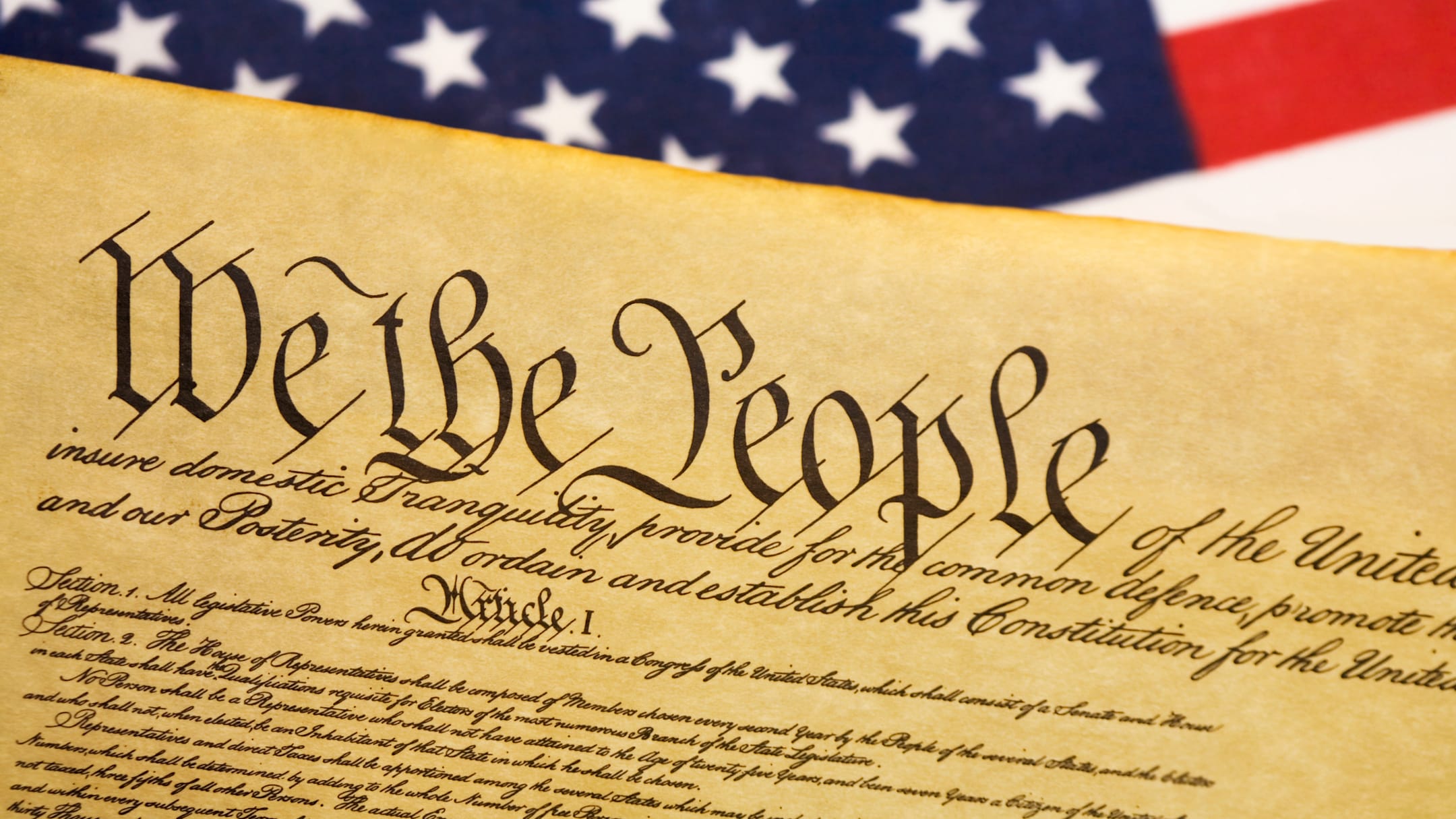
Well, this is interesting. I've discovered anew that political neutrality is discussed at length in our Doctrine & Covenants 134. Sure, I slightly remember it being there, but in light of recent political developments, this section has garnered much more attention in this year's assigned reading. I recommend reading the entire section, which is only 1000 words. Go ahead, open it up, and read it side by side in this analysis.
Also note: as being in the Doctrine and Covenants, this is more than just a church-wide policy, but rather it is part of our canon of scripture. In other words, it has been adopted as doctrine, and will remain so until the section is removed.
Here's a quick summary of what it teaches, in the order of which it appears:
- God instituted governments for our benefit. [1]
- We will be judged (in part) in accordance to how we have acted in relation to our laws. [1]
- A peaceful government requires the "free exercise of conscience, the right and control of property, and the protection of life." [2]
- Ideally, the voice of the people should uphold leaders that "will administer the law in equity and justice." [3]
- Religion is also instituted of God. [4]
- No human law should interfere with free worship. [4]
- Exception: Unless such worship "infringes upon the rights and liberties of others." [4]
- Humans are amenable only to God. [4]
- While civil magistrates restrains crime and punishes, they should not "suppress the freedom of the soul." [4]
- We should all sustain and uphold our respective governments. [5]
- Sedition and rebellion are bad and should be punished. [5]
- We should honor each of our leaders in their positions, so as to avoid anarchy and terror. [6]
- We must also follow divine laws, where we answer only to our Maker (and not to our governments in spiritual matters). [6]
- General discussion on the separation of government and religion. [7-8]
- If we mingle government and religion, one particular religion may be fostered over others. [9]
- Religions have to right to determine fellowship, rules for good standing, and enact certain punishments such as excommunication. [10]
- Exceptions: churches should not interfere with property or life -- no physical punishments. [10]
- We are justified in defending ourselves, our property, and our government against unlawful assaults in cases where "immediate appeal cannot be made to the laws, and relief afforded." [11]
- Preaching the gospel to others should always be allowed. [12]
- Exception: slaves are exempted from being preached to. [12 -- yeah, it's really in there.]
Discussion
It is clear that our Church espouses in our doctrine the idea of political neutrality. Or in other words: the separation of church and state, an idea that very likely came directly from the US Constitution and its Amendments. This is consistent with D&C 101:77-80, which mentions that God "established the Constitution of this land." Also, the Book of Mormon describes a time when judges oversaw the government while a prophet oversaw the religious matters -- again, as separate entities.
To bring this to the hear and now, I'd like to compare this doctrine with the recent rising of Christian Nationalism, which has instilled itself in many of the various Christian denominations, including my own. Many of my LDS friends have repeated to me the idea that our nation was built on Christian principles, and we should strive to instill these ideas back into our government, seeing how "liberals" had removed them along the way.
These tend to be the same people who claim that we need to protect ourselves from Sharia Law, which Muslims would try to enact on us should they gain power. And I can't help but notice the hypocrisy. Sharia Law is bad, while Christian Law is okay?
In either case, D&C 134:9 is clear. No one religion should be chosen over another one, as such would infringe on the freedoms of other religions. You may be interested to read one of my earlier articles: Do You Believe in Religious Tolerance? Take the test and find out if you really believe in and understand freedom of religion.
What is entirely absent from D&C 134 is the idea that government exists only to instill Christian principles. Rather, it clearly states the opposite. Government is for civil law, and religion is for spiritual law. Render to Caesar that which belongs to Caesar, and render to God that which belongs to God.
My Church understands this concept quite well, realizing our own past when Joseph Smith and his people were met with much persecution. Had the Constitution not been in place, it would have been very difficult for Joseph to establish this "true" church in 1830. Our church exists ONLY because the First Amendment allows it. If we can't uphold this principle for other religions and denominations, then what good are we but hypocrites?
I hope you've enjoyed this discussion. What are your thoughts on D&C 134?

No comments:
Post a Comment