Sunday, March 13, 2022

The Families of Abraham


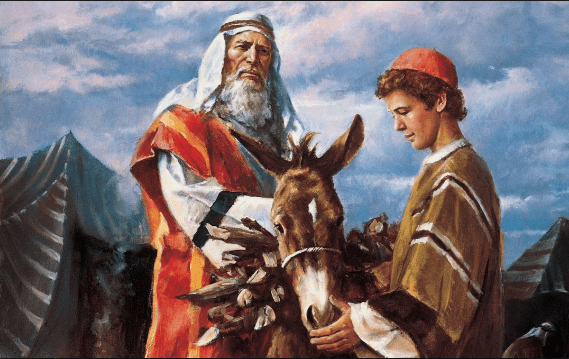
Our Old Testament reading continues. Following the schedule, we are nearing the end of Genesis. This last chunk covers Abraham, his family, Isaac, Jacob, and we've even started learning about Joseph and the other sons.

So let's see. Quick summary ... it starts with Abram (descended from Noah), who marries Sariah. God promises to bless his seed, and changes Abram's name to Abraham. And Sariah becomes Sarah. (Just drop some letters?)

Sarah can't have children, so she gives her handmaiden Hagar to Abraham to wife. Then Hagar gives birth to Ishmael. As Ishmael grows older, Sarah starts to do despise him and Hagar, so she ends up kicking them out.

Then Sarah gives birth in her old age to Isaac -- a miracle. Isaac receives the promised blessing from his father. Ishmael also grows to be a large nation, many of which are Muslim today (Muhammad is believed to be descended from Ishmael).

Isaac marries Rebekah, and they have two twin sons: Esau (redhead) and Jacob. Esau comes out only a few minutes before Jacob, so he gets the birthright. But later, Jacob, with some help from his mother, take the birthright, and Jacob ends up with the Abrahamic blessings.

After wrestling with God, Jacob's name changes to Israel. And then he has 12 sons through four different wives -- making up the future 12 tribes of Israel.

Some random thoughts (in somewhat chronological order):
  • The Old Testament can be surprisingly R-rated. People sleeping with each other, killing, cheating, and the like.
  • The Bible says: "thou ... shalt call his name Ishmael." (Genesis 16:11) So, where's Ahab?
  • At least twice, Abram and Sariah plan to say that she's his sister so that the people don't kill Abram and take her away. Both times, some kind of king takes Sariah, and then in a vision they learn that she is married and God threatens to curse them. And they return Sariah and ask, "Why did you say that she's your sister?" In the second story, there's a plot twist -- turns out Sariah really *IS* his sister -- from another mother. So, cool.
  • Evidently -- after Sarah dies, Abraham marries again and has more children.
  • Isaac ends up marrying his cousin, Rebekah. In a few generations, the idea of Levitical degrees will be introduced. But it seems that at this point in time, this type of thing is permitted.
  • Laban, the father of Rachel, is a jerk. He probably would have kept Jacob as a "slave" forever. At least Jacob got two wives out of it.
  • After twenty years, Jacob feared when he heard that Esau, his brother, was on the way to meet him. Turns out that he just wanted to say hi, and there were no more hard feelings.
  • Judah is such an interesting person.
Trying to get a spiritual thought out of this ... sometimes it takes most of my energy just to get the stories straight. Sometimes I get distracted by all the human imperfections. But still -- these sections are filled with some good parts -- covenants, promises, miracles, blessings for those who follow God, and not so much for those who don't. With God, nothing is impossible. If we do our parts, God will keep up his end of the covenants we make.

Up next -- we're about to get to Moses and his story. Should be fun!!

Sunday, February 6, 2022

The Generations From Adam to Noah


For today's spiritual thought, I'm going to do what I do best -- Math! Sounds spiritual? Perhaps. All things to God are spiritual.

What I did was to take the numbers of Genesis 5 and throw them into a spreadsheet, just to see how things came out. To get a better look of the results, you should double-click the chart above to open a larger version in a new window. Year zero marks the beginning of Adam's life (I'm guessing when he got kicked out of the garden of Eden). And then I go from there.

For example: Genesis 5:3 tells us that Adam was 130 years old when he begat Seth. And then Genesis 5:8 tells us that Seth lived a total of 912 years. So, on my chart, Seth's line goes from 130 to 1042. And so on ... all the way through Noah.

As a bonus, I marked when the flood occurs. Genesis 7:6 tells us Noah was 600 years old when the floods came, so as per the math, this happens in year 1656.

Now armed with this chart, we can attack a myriad of questions. For starters, why does the Bible say that these people lived over 900 years? Methuselah has the longest life span of 969. As such, I've seen several works of fiction refer to "Methuselah" as some device or project that gives eternal life. Enoch has the shortest of 365 because he "walked with God."

But then after the flood, life spans decrease drastically. Could it be some kind of math mistake? Surely those recording the numbers could correctly identify the seasons and count the cycles. Some suggest that perhaps they were counting months instead of years. If we divide by twelve, Adam only lives to be 77 years. But then he's 10 years old when he has Seth. Well -- I suppose he was already grown.

But wait -- Seth would have been 8 years old when he had Enos. That doesn't make sense.

It also doesn't make sense to us that all these people would wait so long to have children. Tied for the youngest are Mahalaleel and Enoch who were both 65 when they had their mentioned child. Most women today are unable to bear children at 65.

So, perhaps we don't divide by 12, but by some other magical number to adjust the generations? Well, let's take Mahalaleel and say he really had a child at 16 (reckoned by our years). That provides us a factor of 4. But Mahalaleel, after this adjustment, is still living 223 years. So basically -- yeah -- there doesn't exist a factor or adjustment that gives us both a believable time for giving birth, and a believable time for death.

Plus, check out that dotted line at approximately year 927. There are NINE generations alive at the same time! Has that happened even once to any family in any of our secularly recorded history? I picked 927 because Doctrine and Covenants 107:53-57 describes a time (three years before Adam dies) when Adam gathers together the generations listed above from Seth to Methuselah, and blessed them. I note that Lamech was supposedly alive at the time, but was perhaps not old enough to be a high priest?

And get this ... Lamech dies just a couple of years before the flood hits. And Methuselah? He dies the same year as the flood. What? Did they forget to bring him on the ark? Did he go bad in the end? Poor Methuselah! (Perhaps God waited for him to die before releasing the flood waters?)

And lastly -- one more concept. Genesis 5 lists only one son for Adam, and that was Seth. But we know that Cain and Abel were born before that. And Genesis strongly suggests that there were many children born prior to Cain and Abel -- otherwise, who were those other people Cain went off to and got married? The Joseph Smith translation of Moses also seems to indicate that many were born before. Moses 5:2 states they bare sons and daughters. And then verse 16 mentions Cain. And then Abel comes in verse 17.

So, there's no reason to believe that each child in that lineage was necessarily the first born. It could be that Cain and Abel were mentioned above the others because they were the first murder to have occurred.

So -- why is Seth mentioned over all the thousands of other children Adam may have had? And then why Enos? And then why Cainan? Simplest answer -- there's only one lineage that takes us to Noah. Some call this the "righteous lineage." Perhaps each person in this lineage was particularly more "righteous" than his brethren, and thus more likely to pass on righteous teaching to their children.

And again -- all of these numbers could have been made up after the fact or corrupted through oral traditions. Either way, it was fun to make this chart. Enjoy!!

Sunday, January 16, 2022

The Fall of Adam and Eve


Looks like I have a lot to say this first part of the Old Testament. You get another blog post (but don't worry -- the Elders will be back soon). This time it's about Adam and Eve.

Judaism, Christianity, and Islam seem to have the following points in common concerning the "Fall":
  • Adam and Eve were living in the Garden of Eden in a perfect state. That is, no sickness, no death, etc.
  • Adam and Eve were innocent -- meaning they had no knowledge of evil.
  • God planted the Tree of Knowledge of Good and Evil in Eden and provided two commandments: Be fruitful and multiply AND do not partake of that fruit. Eating the fruit meant they would die.
  • A serpent tempted Eve to partake of the fruit.
  • Eve then got Adam to partake.
  • God appeared, cursed the serpent, and casted Adam and Eve out of the Garden.
  • Then death, pain, evil, and all kinds of other bad things came into the world.
But when you look closer at each religion there are a few subtle but very important differences. 

Most Christian denominations see this as the "Fall" of Adam and Eve. All they had to do was to NOT partake of the fruit -- one simple task -- and then we would all be living happily with no sin and death. It would be a wonderful world. But Adam and Eve messed it all up, so now we must all suffer. Jehovah's Witnesses even go so far as to say that Adam and Eve are permanently dead (as punishment) and will not be resurrected because of this direct disobedience to God.

But then the Book of Mormon and the Doctrine and Covenants of my church sheds more light on the subject. 

First off, let me ask you a question. Have you ever wondered why God placed the Tree of Knowledge of Good and Evil in the Garden? We'll call this the Knowledge Tree. I must be specific here, because God placed that other tree as well: the Tree of Life.

It seems that if God had really wanted no one to partake of the Knowledge Tree, He could have simply NOT put it there in the first place. Then there would be no temptation, and we would all be living happily.

Before I continue, I must share that once when I asked this question, someone accused me of being blasphemous for questioning God's motives and for even suggesting that God makes mistakes. Needless to say, that particular discussion pretty much ended there. But I do not ask this question in an attempt to prove God is fallible and unreliable, but rather I'm simply asking the question so that we can have a better understanding. If we hold to the assumption that God cannot make mistakes, then asking the question helps us to better understand the true purpose behind what He did.

Taking this a little further, let's say Adam and Eve never partake of the fruit, and then there are millions of progeny running around without sin. All it would take would be just one person to eat that fruit, and it would unleash death on everyone. As an actuary, I can calculate the odds of someone eating the fruit, and with millions of people having access to it, those probabilities are very high .... more than 99.999999999999999999%.

I naturally come to the conclusion that since God placed the Knowledge Tree on Earth, and since God doesn't make mistakes, He was planning for someone, somewhere, at some time to eat that fruit. It therefore seems to be an important piece of His plan. He knew exactly what was going to happen, and He was ready for it.

And that's what my church teaches:
  • Partaking of the fruit was necessary to instill the knowledge and ability of procreation.
  • Partaking of the fruit opened the door to two deaths: Physical Death and Spiritual Death.
  • There must be opposites in all things. You can't have true joy unless you understand sorrow. Likewise, you really can't be good unless you have knowledge of evil.
  • Humans are here on Earth to be tested. This requires the knowledge of good and evil to enable us to make decisions.
  • The first great decision was deciding which of the first two laws to follow: Procreate, or refrain from eating the fruit? They couldn't do both.
  • Death and all the other bad things in life give us experience and help us to become better people.
And then come my thoughts. Who wouldn't want the knowledge of good and evil? Satan actually asks this question as he tempts Eve -- and well, the master of lies is adept as using truth as part of his tactics. His goal was to bring evil into the world so he could have a measure of power. But I must admit -- isn't knowledge always a good thing?

Think of a little toddler -- all innocent and cute with no real knowledge of what's good and what's bad. How many times have you seen a toddler do something bad (like punching a sibling) without fully understanding what he was doing? Having no knowledge of good vs. evil does not stop a person from committing evil. Rather, the person is free from any judgement -- because they didn't know any better.

Likewise, Adam and Eve, in their perfect state, were free to do anything they pleased. But without the knowledge of good and evil, they could perchance perform evil acts as well -- because they wouldn't know any better. What would stop them and their progeny from committing adultery? Or from stealing? Or from hurting others? Avoiding these acts is impossible without knowledge.

It's kind of the age-old paradox: would you rather know what you're doing wrong, so you can stop doing it and be happier? Or would you rather not know that it's wrong so you never feel bad about doing it? From above, it appears much more desirable to have knowledge so you can increase your happiness in the end. In other words, making good decisions with knowledge, to me, is preferable over living in ignorance.

That's why I think the following (which I never noticed before until today): What if God placed the Knowledge Tree there intentionally because he wanted humans to have the choice to partake? Kind of like a contract. Adam and Eve knew beforehand what the stakes were. God told them what the tree was: eating of the fruit would give them very valuable knowledge, including how to have children. But it would come with a price: death, sickness, being cast out. They could have chosen NOT to partake, and they would have lived alone for an eternity in the Garden, living peacefully, but missing out on the bigger blessings now available to all of us.

But, they ultimately decided to partake. Perhaps they saw both the benefits of the knowledge and the price and decided it was worth it. We also have no idea how long it took them to make that decision. Were they millennia in the Garden before the Fall, or was it just one hour? We don't know, but then again it doesn't matter to us. We are in the state we are in now, and we can do our best to return back to Him, through Jesus' redemption for us.

So, there you have it. A summary of what my church believes, how it defers from most denominations, and also my additional thoughts. I hope you've enjoyed these ramblings, and as always, you can let me know what you think.

Sunday, January 9, 2022

Does God Know When We Are Going to Die?


I know -- I've already done a spiritual thought for the month, and I need to get back to the second "Elder Elder and Elder Benjamin" story. But I feel impressed to share this important thought from my reading this past week.

Over the past year, in response to the pandemic, I've heard the religious say things such as: "My days are numbered, and God knows when I'm going to die" or "if it's my time to go, then it's my time" or even "I do not need to fear because I can trust in God and He will protect me -- unless it's my time to go."

It's given me much to think about over this past year or so. Does God know when I'm going to die? Of course -- if He's omniscient, then He knows everything -- including when I'm going to die. So, to answer my big OP question simply, the answer is: Yes. He knows when I'm going to die.

Often in the Bible, the concept of "your days are numbered" is usually coupled with the idea of "the Lord will protect you, so do as He commands." For example, Jesus tells the apostles in Luke 12:7, "But even the very hairs of your head are all numbered." In other words, "go and do what I command you and I will protect you."

Is this day of death set, then? In other words, has God determined that I'm *supposed* to die at a particular time? Will I be called to an already specified mission when I die? And so on...

In the Calvinistic tradition as I understand it, predestination dictates that, yes ... that date is set, and there is absolutely nothing we can do about it. We can only make the most out of our life until that day comes.

But then, the Bible gives us some interesting clues, such as in 1 Kings 3:14, when the Lord speaks to Solomon.
And if thou wilt walk in my ways, to keep my statutes and my commandments, as thy father David did walk, then I will lengthen thy days.
This implies that that date can be changed in accordance to how we live out our lives. Here Solomon appears to be given a choice: keep commandments and live longer. Or don't keep the commandments and die sooner. So, the day of death may not really be set -- or perhaps it may be contingent on the choices we make.

And then -- this past week as I was reading in the "Saints" book (continuing my Church History self-study), I came across an interesting story. In the first volume, page 373, it tells the story of Wilford Woodruff's wife Phebe. As she lay sick, she claims that she died and saw two angels approach her. One said to her: you can choose to come with us and earn your eternal rest, or you can go back and endure the trials that lay ahead. After seeing her husband and others frantically trying to revive her, she quickly choose to return.

She was given a choice!

And that was just one such story I've heard. I'm sure that regardless of the domination you belong to, you've heard similar near-death experiences. The fact that my church chose to include this story in an official book implies that it was a true experience. Sometimes we really can choose when to die.

Is this a contradiction? God knows the day we're going to die, but somehow we can make choices that can change that date? So, which is it?

My wife gave me the perfect answer: Well, God knows the decisions that you're going to make. So, while we have free will to make choices, He knows what choices we'll make that will lengthen and/or shorten our time of death.

If you think about it, what if I were to go to some cliff to test God's protection and throw myself off? Do you think that God would cause a wind to slow down my fall because it's not yet my time? Or rather would God let me die, and tell me later: "Why did you do that? I knew you were going to make that decision, but really?"

So, yes -- God does know when we're going to die. And yes, our days our numbered, but yet, it turns out that we do have input into when that day comes. Do we want to live long? Then we can make appropriate decisions to help extend our own days. We can follow the Word of Wisdom for healthy living. Or we can learn how to stay out of dangerous situations. Each of these require some kind of action or decision making on our part -- exactly as did Solomon and Phebe Woodruff.

Or we could do nothing but solely "rely on God" and end up being taken at an earlier time because we didn't do what it would take to extend our days. 

It really is up to us, and if we turn to God, He can help us know what we should be doing or choosing to extend our own lives.

Sunday, January 2, 2022

The Martyrdom of Joseph Smith


As a reminder, my church's weekly reading for 2021 was all about the Doctrine and Covenants and Church History. I thoroughly enjoyed learning more about this church I've belonged to for decades. Even though I thought I had known everything, there is evidently always more to learn.

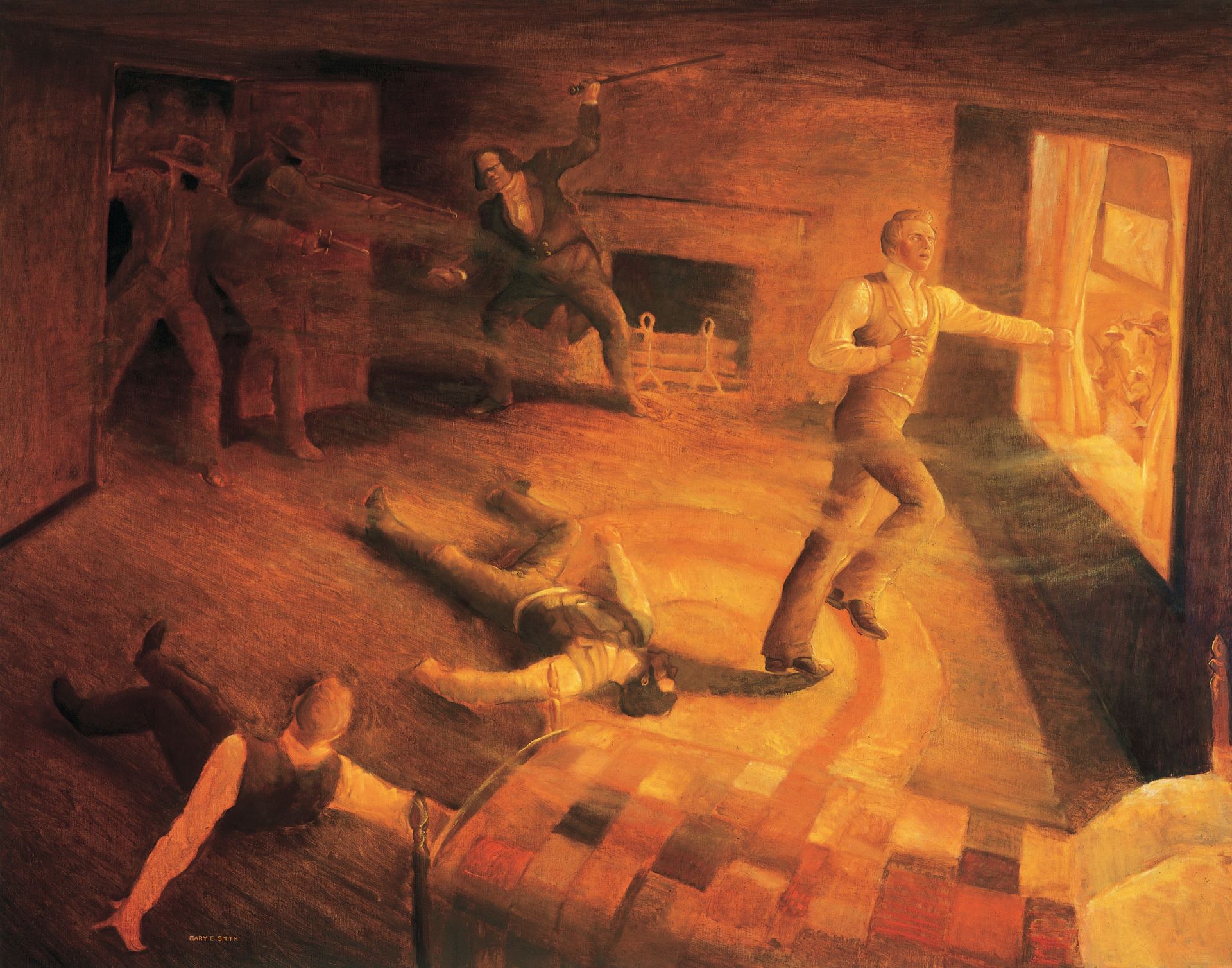
In December, toward the end of our reading, we revisited the martyrdom of Joseph Smith. As you can see in the picture above, he was killed by an angry mob. As he and his colleagues were being held on the second floor of Carthage Jail awaiting trial, an angry mob was allowed to storm and attack.

The man lying in the middle was Hyrum Smith, brother of Joseph. He died instantly when the mobsters entered the room. Off to the left in front of the bed was John Taylor, who was shot several times. A watch in his breast pocket stopped a fatal shot, and he survived to later become a president of the church. Behind the door in front of the fireplace would be Willard Richards, who didn't get hit at all -- supposedly because he was out of the line of sight of the mobsters.

And Joseph Smith was the man jumping out of the window. He reportedly died from his wounds before he hit the ground.

Those of you who do not belong to this church may wonder: was this murder, or was it justified? Did Joseph Smith bring this upon himself? 

John Taylor claims in Doctrine and Covenants 135, verse 7:
... their innocent blood on the floor of Carthage jail is a broad seal affixed to "Mormonism" that cannot be rejected by any court on earth, and their innocent blood on the escutcheon of the State of Illinois, with the broken faith of the State as pledged by the governor, is a witness to the truth of the everlasting gospel that all the world cannot impeach; and their innocent blood on the banner of liberty, and on the magna charta of the United States, is an ambassador for the the religion of Jesus Christ, that will touch the hearts of honest men among all nations;
So, innocent blood on the "banner of liberty" and the "magna charta of the United States"? Is it really appropriate to go that far? Or is this more of a hyperbole?

To answer this last question, the actions and lack thereof from officials at every level of government speak for themselves. The "Mormons" (as they were called by their enemies) were kicked out of Ohio, and then kicked out of Missouri -- county by county until Governor Boggs ordered their expulsion from the state by threat of extermination. And then following the martyrdom of their prophet, they were kicked out of Illinois, and ultimately out into the unorganized territories.

And with each expulsion, the "Saints" (as the members called themselves) were forced to give up property without recompense, and were often killed and raped. And each time, the church leaders would reach out to governors and even the President of the United States, himself, and no one raised a finger to stop the illegal happenings.

No matter what one believes about the truthfulness of what Joseph Smith taught and what he claims, it should be as clear as day that due process had been thrown out the window. None of the protections that the Constitution guaranteed -- none of the Bill of Rights -- were allowed to apply to these Saints.

And it didn't stop until the Saints found a home in the middle of a desert that no one else wanted, which would later become Salt Lake City.

So, yes -- it was definitely innocent blood on the banner of liberty and on the United States. Not only because of Joseph Smith's unlawful murder, but also because of how the US allowed the followers of this religion to be driven out. All these events, which transpired for over a decade demonstrated a gross failure in the US Constitution.

And yes -- I know I'm a little biased in this matter. There is definitely more to the story -- how the Saints egged on some of their detractors. We got to learn a lot about that side as well this past year. It's very possible that had they behaved differently, our Church would still be centered in Independence, Missouri (the identified place of Zion). But we are where we are.

Joseph Smith definitely left in a blaze of glory, and his martyrdom has locked in a testament that has helped his Church to grow exponentially.

I hope you have enjoyed some of these explorations into Church History this past year. For 2022, we move on to the Old Testament. For being the largest book, that's going to be a lot of reading! We'll see what spiritual thoughts I can glean from it.

Saturday, December 4, 2021

The Righteous Need Not Fear


Sometimes, it's easy to wonder if the final days are upon us. Prophesied are plagues, pestilences, famine, wars, earthquakes, storms in diverse places, and so on. Sounds kind of scary? Let's take a look at what the Book of Mormon has to offer. I suppose I could turn to any similar verses in the Bible or in other scripture, but the language of 1 Nephi 22 seems to match the closest to what I'd like to point out today.

After describing scenes of destruction and the like, there is this interesting promise in verse 17:
Wherefore, he will preserve the righteous by his power, even if it so be that the fulness of his wrath must come, and the righteous be preserved, ... Wherefore, the righteous need not fear...
Okay -- I'll let you think about that. It almost seems impossible. Fire falling from the sky. Earthquakes everywhere. Storms wreaking havoc. Wars killing people. And somehow the righteous are going to be magically protected? The fire is going to know to only fall on the wicked? Earthquakes will know to swallow up only the wicked? Storms will know how to seek out the wicked?

But wait -- aren't we going through a plague right now, and isn't killing people indiscriminately? It seems to be killing Christians, Jews, Muslims, Buddhists, atheists, etc., regardless of what one believes. Is one group not getting more protection than another? Or is this one of those "the rain falls upon both the righteous and the unrighteous" situations?

Is the promise in error?

Let's look at several instances in the Bible where a destroying angel has visited.

Instance #1) The Passover -- probably the most famous example. The Lord sent a destroying angel to punish the people of Pharaoh -- to take the first-born sons. And the Lord arranged a way to protect the people of Israel.

Instance #2) The brass serpent of Moses (as I recently covered). Snakes were biting the people of Israel as a punishment for their sins. But then the Lord provided a way to survive the snakes.

Instance #3) Sodom and Gomorrah were slated to be destroyed, but the Lord saved the righteous.

Instance #4) The End Times. The Book of Revelation describes destroying angels who are commanded to torment and kill men. However, the Lord promises to save the righteous.

In each of these cases, the Lord provides a way to escape destruction, but is it enough to be righteous and/or belong to the "True Church"? Let's take a closer look.

#1) The Passover: in order to make the destroying angel pass by, the Jews had to place lamb blood at the top of their door posts. Households who failed to do so would lose their firstborn sons.

#2) The brass serpent of Moses: people were required to look up to the brass serpent to live. Those who did not were likely to die.

#3) Sodom and Gomorrah: the righteous were required to leave the city before the destruction began. Lot and his wife were the last to go, and angels came to escort him out. Anyone who happened to stay in the city perished.

#4) The End Times: to survive the destroying angels, each person will have to have the "seal of God in their foreheads."

Do you see a pattern? In each case, belonging, or being chosen, alone, was not enough to save the people. Each person had to take actions in order to survive. And get this -- those who did not belong and who happened to follow the instructions would also survive.

And it will be the same in the End Times. Those who follow the required actions will have no need to fear.

But how do we know what actions we'll have to take? The Lord will let us know when the time comes. 1 Nephi 22 gives this answer in verse 20:
And the Lord will surely prepare a way for his people ... : A prophet [Jesus Christ] shall the Lord your God raise up unto you, like unto me; him shall ye hear in all things whatsoever he shall say unto you. ...
Again in verse 22: "the righteous need not fear, for they are those who shall not be confounded."

And again -- we see that same pattern. We will need to take action, and that action is to Hear Him. Those who listen will be guided into safety.

Finally, we can come back to our current plague and take a closer look. What have today's "prophets" been saying?

I'll start with my own church (the Church of Jesus Christ of Latter-day Saints). Several times, the First Presidency, and even the Prophet, President Nelson, have urged us to get vaccinated, wear masks, and to follow the recommendations of medical experts and leaders. In particular, President Nelson had urged vaccinations as early as January 2021, calling the vaccines a "godsend," and then reiterated with the First Presidency in an official statement in August 2021.

Catholic Church: the Pope has urged vaccinations, calling them an "act of love." He has also declared the shots to be "morally acceptable for Catholics."

Southern Baptist Convention: the President got vaccinated in April and stated that "these vaccines are cause ... to celebrate and give thanks to God," and said that vaccines would get churches full again sooner rather than later.

Presbyterian Church -- General Assembly: calls on its members to "seek the good of the city" and "to love the Lord your God ... and your neighbor as yourself" and get vaccinated.

United Methodists: vaccines are opportunities to love your neighbors. The UMC leadership wish to give people information and empower them to understand how to protect themselves, their families, congregation, and community.

Jewish Leaders: The Rabbinical Assembly states that Jews are obligated to vaccinate themselves and their children.

The Dalai Lama: urged people to "be brave and get vaccinated."

American Muslims: All tools to fight Covid19 should be employed. The vaccines are deemed permissible. Allowing the disease to spread unchecked is against Sharia law as it risks the lives of people.

And so on ... I think you get the idea. Practically all major religions are consistent with the same message: "do these things and survive." In particular, vaccines are approved and/or urged by most religions. As God sends His guidance on how to navigate through this pandemic, the message is clear.

Who have been surviving? Those who follow all of this counsel. Not just the religious, but even atheists who have been following the same guidance. This includes, most recently, those who have gotten vaccinated. And before that -- those who have worn masks, practiced social distancing, cooperated with contact tracers, and so on. The numbers are very clear -- those who follow these instructions are coming out very well -- most are avoiding hospitals and death.

So, it turns out that the Lord's promise is still with us after all! Sure, the rain still falls on both the righteous and the unrighteous, but why shouldn't the righteous fear? Because God gives us umbrellas with instructions on how to use them. Those who follow need not fear because they are following the Lord's instructions, and they are prepared. And not only that -- they are also not confounded. That is, while others are confused, the righteous can see with simplicity and clarity.

As the End Times approach, this pandemic is just one test -- something to warm us up. Are we willing to follow the promptings of our religious leaders as the Lord sends us these tribulations? Or will we choose to go all on our own and hope for the best? Wouldn't it be great to navigate the End Times with knowledge and clarity?

The choice is up to us. As long as we follow the Lord and His instructions, we will indeed have no reason to fear.
Sunday, November 28, 2021

Introducing the Adventures of Elder Elder and Elder Benjamin


While serving in Pusan Korea Mission in the late 1980s, Elder Elder and Elder Benjamin experience many exciting and crazy adventures. Miracles, shenanigans, conversions, and even mishaps abound.

These partially fictional accounts come from my own real-life experiences in Korea. I'd say around 95% of what you're about to read actually did happen. I only changed the names and took several literary liberties.

In particular, I really did have a favorite companion -- a fact known by practically all the other missionaries who served with me. I was with him for five months in Taegu, and it really was the best five months out of the "best two years of my life." We were as crazy as I make it sound -- a force to be reckoned with -- missionaries who caught the attention of the Korean people and who successfully planted many seeds. However, in these stories, I also borrow from other times in my mission. 

All of my companions were great, and some of them may make appearances in some form, but for convenience, they are all merged together into Elder Benjamin.

I also went on a split once with an actual Elder Elder. Even though he doesn't really appear in this set of stories, I've decided to swipe his name to represent myself, because it's definitely a cool name. It's up there with Bishop Bishop.

These stories should hopefully bring back good memories for those who served missions. And for those who don't belong to my church, I hope these stories provide deep insights into what it's like to serve a mission. They can help answer the question: what was I doing for two years?

Enjoy! As I write more stories, they will all appear here (in chronological order):