Sunday, November 29, 2020

The Limits of Science


For this week's spiritual thought, I'd like to touch briefly on the topic of science vs. religion. This is something I'll explore on a much larger scale when I finally get back to my "Why I'm a Latter-day Saint" book. But for today, it'll only be a quick introduction.

I love science. My father instilled in me, when I was very young, a sense of critical thinking and a love of space. He would show me things through his telescope and encourage me to read all kinds of books on math, science, and logic. And that was all before I was 5 years old.

This was further solidified when my 6th-grade science teacher, Mr. Alhadeff, introduced me to Carl Sagan. He encouraged me to watch the original COSMOS "live" on PBS, and I fell in love with all of Sagan's philosophy, instruction, and exposition. 

In hindsight, I can see that this background has given me a very strong handle on life and has helped me to prosper. In fact, the current CEO of one of the largest banks in the US told my wife a couple of years ago that I was the smartest guy at his bank. I disagree with him, but it's the impression I leave on most people who know me. (People who really are smarter than me just shake their heads -- they know I only appear to be smarter because I'm also such a friendly guy.)

And yet, I hold to my faith strongly. Most of my "smart" colleagues tend to be agnostic (not really atheists), and I am like an enigma to them ... with everything that I know, why do I believe in God?

Perhaps I blame Carl Sagan. Even though he was no friend to Christians or any organized religion, he admitted several times in his COSMOS show that there are things we just don't know. Science is limited. There is always more to learn, and science is a very useful tool. However, it can never explain questions in the "why" category. For example, science may be able to describe how the universe was created, but it could never answer WHY it was created. Most scientists are likely to throw up their hands and say, "Why are you even asking that question?"

Much science fiction imagines a world in which we outgrow religion, but I don't think it'll ever go away, because as humans, we will always ask "why?" And science will never be able to answer that question. So, there will always be room for religion. Scientists tend to call this the God of the Gaps, but I'll save that for later. You would not believe how large and engaging this discussion can become.

I'll give a little taste here. I know a napkin proof exists that it's mathematically impossible to prove or disprove God. I'm still working on it, though. I think it might include these elements: In order to prove God exists, one must prove that he (or it) is more than one's imagination, but one cannot even prove that one's view of reality exists. To disprove God, you can't overcome the "God made it look that way" argument, OR one must obtain godlike knowledge, which ends up creating God.

Yeah ... that napkin proof still needs work. But I know that God will always exist outside the realm of science, math, logic. This is why logical discussions and arguments are very weak in converting people in to or out of religion. One can only acquire spiritual matters through spiritual means. I know that God and Jesus exist, not because of my awesome analytical skills, but because of my feelings and my experiences. 

I know that ultimately there is no logic in the singularity behind what I believe, and I'm perfectly fine with this. Because, ultimately, there never was any requirement for this logic to exist. I know the limitations of logic, math, and science (Hofstadter's Gödel, Escher, Bach is also highly recommended reading), and I see exactly how both science and religion help in my life to give me fuller understanding and perspective in life.

There is so much more on this to come later ...

Sunday, November 22, 2020

Give Thanks (Hashtag)


I direct this week's spiritual thoughts to all my non-Mormon friends. Well, the message is for everyone, but I thought I'd take this time to explain what all this #givethanks hashtag is all about. I suppose it speaks for itself, but here it goes anyway.

It is a challenge presented by the current prophet and leader of our church, President Russell M. Nelson. In the attached video, he expresses concerns that our world is currently going through turbulent times. It's not just the pandemic, but also political strife, and all around anger and despair everywhere threatening to tear everything apart.

And he posits that the best cure for what ails us is a healthy dose of gratitude ... just in time for Thanksgiving. So, he challenges everyone -- not just us Mormons, but everyone who hears the challenge -- to flood social media with sentiments of thanksgiving. He provides the hashtag #givethanks as a way to mark this effort. The idea is that if we can see all the good in our lives, even during turbulent times, then perhaps we may be able to start working together instead of against each other.

It makes a lot of sense. Thank back a year at all the posts you've seen on social media. How would you describe these posts? How would you characterize them? My own observation is that a good 90% of them have one thing in common: anger -- lots of anger. 

For the past few weeks I've bemoaned the "Anti-Hype" effort that is helping the spread of the virus exponentially. This is a series of posts, articles, news conferences, etc., that propagate the ideas that the virus is nothing, or that it's not dangerous, or masks are ineffective, or anything else that promotes actions that actually work to spread the virus. And all of these posts on social media have that one thing in common: anger, whether it be in the form of conspiracy theories, overblown ideas of freedoms being infringed, or other ideas scientifically engineered to get a contentious response. The idea being: get the people mad so that they will want to stand up and fight.

And the same is also true of political posts on both sides of the aisle. Practically every post contains some kind of warning: "You don't want this to happen" -- again, scientifically engineered to get a contentious response. And sure enough, we, being human, eat these posts for breakfast. We get angry. We feel like we need to do something about it, and we propagate the contentious ideas.

But reality, or "truth," is never found through contention. And often the threats and warnings are unfounded or exaggerated.

This whole #givethanks effort is the exact opposite of what we're used to on social media. If we can see our blessings, then all of a sudden, our fears and wants don't seem quite so bad. And then perhaps we may be able to listen to each other -- realize that we're not enemies, and start working together.

That would be a dream come true for me!

As Pres. Nelson says in the video: "Counting our blessings is far better than recounting our problems."

So, give it a try. Watch the video, and decide for yourself. Flood social media with a week of thanks, and read everyone else's proclamations of thanks, and realize what good people we all are. Perhaps some good will come out of this, and perhaps we'll start working together and enjoy the synergy from combining ideas together. It's happened before, and it can happen again.

Sunday, November 15, 2020

The Pride Cycle


Today I'd like to discuss the pride cycle, a theme that permeates the Book of Mormon. Though, it comes from Latter-day Saint scripture, this is a universal concept that all religious people can appreciate.

The cycle begins when a society is doing well. When the people are rich and prosperous, they start to become prideful. They see the success around themselves, and then decide they don't need God. People act more selfishly, cast out the poor, and even covet power.

Then God sends some kind of calamity. In the Book of Mormon, it's usually the Lamanites coming in to kill a lot of people. The people are brought down to humility and start to remember God. They pray for forgiveness. They start to treat everyone else more kindly. Then comes a period of rebuilding, and because of the peace and good intentions between everyone, it comes back to the beginning of the cycle.

It's almost funny how many times this cycle happens in the Book of Mormon -- almost always from the point of view of the Nephites. A few times it turns out that the Lamanites are more righteous than the Nephites. And the whole time I'm thinking, "You know ... wouldn't they figure it out eventually? Wouldn't they see that turning to God and helping each other is the way to peace and prosperity? Wouldn't they look at what happened 20 years ago, and not ever do that again?"

Even miracles like the sign and star of Jesus only brought peace for a few years. Then it was quickly back to pride and secret combinations. When Jesus appeared, himself, it appeared to break the cycle. It took a little more than 160 years before people started turning back to pride. Then, they got really low, and this time, they didn't come back. The Nephites stopped turning to God completely, and their sorrow was not spiritual sorrow. Shortly after that, they were wiped out by the Lamanites.

Is it possible for us humans to be rich and prosperous, while at the same time remain humble, caring, and inclusive? I emphatically say, "Yes." There's a way. In fact, I think God wants us to be prosperous. He says as much when he gave Adam the first commandment to be fruitful and multiply. He has indicated that he wants us to succeed. We just have to remember God, and then we'd live in a much happier world.

It seems we prove time and time again that when left to our devices, we screw things up royally. The fall of a society almost always comes after a time of great prosperity. And here in the United States, we have clearly been experiencing great prosperity, economic strength, and untold riches. But we also have great pride, inequities, murders, and hurtful scams. People are full of pride as they look for ways to take advantage of others -- such as buying hundreds of rolls of toilet paper during a pandemic with the hopes of selling online with exorbitant profit. 

Every year, here in the states, it seems to be getting worse, and people lose a little more faith in each other as it progresses. They are also more and more forsaking God, attributing all the riches to their own devices and cunning. As we become more prideful, divisive, uncaring, and exclusive, what could possibly happen next but our own downfall?

We can only do our best and try to help others to do their best. Remember God. Remember why we're here on earth. Be humble. Remember where all our blessings come from, and we could achieve that perfect society of a God-loving rich and prosperous people.

Sunday, November 8, 2020

Peace, Be Still

 
Inspired by a post by my aunt this past week, I'm reminded to remember how God knows our fears. He knows our troubles, and our concerns. But he's got this. He knows where we're going, and what's in store for us.

This was one message we received from our church leaders last month in General Conference. Trust in God and he will take care of it.

Some people are deeply disappointed with election results this past week. For me, it's the coronavirus outbreak that is causing me a lot of my grief and stress, especially when I know we could have handled it better than we have. And I know there are yet other sources of stress -- chances are, you are suffering from some kind of storm.

But think on this. There are two types of storms. 

First, there are the external storms. In the case of the coronavirus -- it's a real event killing lots of people, and giving permanent side effects to many survivors. It's causing markets to crash, and even causing other indirect deaths. It is a storm -- not of my making, but something we all have to deal with.

Secondly, there is the internal storm. With the coronavirus -- exactly what can I do about it? I'm just one person with no power to influence anything. What is the danger to me? I could catch it, but that's about it. I may die ... I might not, who knows? So, I can do the best I can to protect myself. Perhaps I could help my friends and family protect themselves as well. But beyond that, there's nothing much more I can do.

Is it worth beating myself up over it? When it comes down to it ... not really. Doing so creates the internal storm that many of us have. In other words, this second storm is self inflicted. We can't choose our external circumstances, but we can choose how we react to them.

This is where Christ and God come in. The video above tells the story of how the artist, Howard Lyon, came to draw the story of Jesus stopping the storm on the boat. He helped his disciples in their time of need, and he can help us in our time of need. We really can have peace in the midst of our external storms. We can learn how to quell our internal storms and enjoy peace.

I invite you to try it for yourselves. Pray to God. Ask for help in quelling your personal storms, whatever they may be. Then you may come to enjoy peace during times of crisis. God has this. He will lead us where we need to go.

Sunday, November 1, 2020

Enduring to the End


Enduring to the end is a fundamental principle of my church, the Church of Jesus Christ of Latter-day Saint, but the concept itself comes straight from the Bible.
Then shall they deliver you up to be afflicted, and shall kill you: and ye shall be hated of all nations for my name's sake. And then shall many be offended, and shall betray one another, and shall hate one another. And many false prophets shall rise, and shall deceive many. And because iniquity shall abound, the love of many shall wax cold. But he that shall endure unto the end, the same shall be saved. (Matthew 24:9-13)
This is something I've lived by my entire life ... or at least I try. I don't know how many times I've been surrounded by people who said, "This is impossible," only for me to take it as a challenge. Sometimes it takes an all-nighter, but I find great pleasure in the end when I deliver and people say, "How did you do that?"

Once at work, we were asked to present our data in a new format. I'm talking millions of data points and very little time to compile it for submission. To do it manually would take days. My superiors went to a professional contractor and asked how long it would take them to create an automated process. They said, "18 months, and it's going to cost you a lot of money." When my boss told me that, I said, "Are you kidding me? I could do it much faster than that." In a couple of weeks I had a fully functional system going. Of course I had people helping me, but it was my code that writes code that writes code that made it all work. There was even an all-nighter in there ... till 1AM on a Friday evening with superiors looking over my shoulder in anticipation. But we beat every single one of our competitors -- we were the only one to be able to present our data in the correct format by the Saturday meeting, while every other company was asking, "How do we do this?" I (and my partner in crime) got a personal thank you note from the CEO.

This type of persistence has helped me succeed in life. But I'll admit -- it's so easy to get tired. How many times have you gauged the amount of effort it would take and then decide to go watch TV or play video games? I think it happens to all of us. And I'm certain that every single one of you readers has had similar experiences where you've gone the extra mile to accomplish that special project. Or perhaps even when you saw how to accomplish something when no one else could.

When it comes to spiritual matters, though, sometimes I feel I fall short. I can think of a long list of tasks that I don't do. I'm not the best "ministering brother." I don't read my scriptures every day. I don't always say prayers before eating. Sometimes I wonder if I'm missing my opportunity to succeed in these matters. I really hate check lists (as I've mentioned before), but I really love challenges. In spiritual matters, I think I'm doing okay, but I could always do better. Am I "enduring to the end"?

I think the biggest lesson I've learned is simply this: Don't give up. As long as you're trying, you're "enduring." We'll always fall short in some areas. Nobody is perfect. It's only when we give up that we guarantee failure.

So, if you want to endure to the end, just don't give up. Keep on trying. And then eventually success will follow.

Sunday, October 25, 2020

Warnings From Jesus


During this pandemic, my local church holds these priesthood Zoom meetings twice a month. Every now and then, the lesson makes it here to these weekly spiritual thoughts, and evidently today is one of those days.

Around A.D. 60, the Jewish people in Jerusalem were not happy. As contention increased, they rose up -- first in smaller rebellions, and then in bigger ones. As a result, the Romans came in en force and put a rest to the rebellion, destroying the temple, and killing more than a million Jews, and capturing 100,000.

However, according to Josephus' account, there is no mention of Christians perishing in these attacks. How did they escape? Readers of the New Testament may already know the answer -- they were warned by Jesus. He spelled out the signs, and the Christians saw them and knew what to do to avoid capture and death.

This article explores the whole idea of Jesus preparing his people for the upcoming Roman siege:


I strongly recommend reading that article, and then come back here, because think on this: If Jesus felt it was important to warn the Christians for an event that would occur more than 30 years later, then why is it that the leaders of my church felt it necessary to give us the most political "talking to" I've ever seen my whole life at a General Conference?

For those who don't know my church, we have worldwide conferences twice a year -- usually 5 sessions of two hours each over one weekend. I listened to 4 of those sessions three weeks ago, and practically every talk was about current events ... riots, plagues, contention, racism, and so on. That was eight hours of warning and guidance on how to survive times like these.

Further, in our bi-monthly priesthood meetings, we go over talks in the most recent conference ... meaning we're going to be discussing these topics for another 5 months before the next conference in April begins.

It's funny ... my wife asked how I felt to have the same lesson two times in a row, and I answered, "We got a whole lot more coming!"

The last meeting two weeks ago was on "Love Your Enemies" by Dallin H. Oaks. This week, we took on the same talk, but explored different aspects ... how to avoid contention, and how to recognize warnings from the Lord.

Our instructor took on some pretty heavy topics, and did a good job discussing it while at the same time keeping us from delving into divisive political talk. I don't think anyone said "Trump" or "Biden" at all, and it was pretty nice.

But for today, I'm focusing just on the warning aspect. Because, I think it ominous that our leaders (who I believe to be inspired by the Lord), showed enough concern to give us some pretty scary advice. 

Elder Oaks' talk seems more geared toward avoiding what may come next. Even before Trump became president, I had been complaining about how much we were divided, and we were increasingly becoming so. It only seems to get worse and worse every year that progresses -- so much so that I no longer refuse to take a side -- I am now "unaffiliated." And this year has been particularly bad. People are becoming increasingly more polarized, and much less willing to have good open discussions with each other.

There is no more a desire to work things out, but rather to work to remove opponents from power, to lob insults and disrespect, and to say their opponents are completely wrong and the sole cause of today's ills.

There is only one outcome to such a trend. Just as the Jews let contentions build up, and riled up the Romans, I think on our current path there is no way for us to avoid the strangest civil war we've ever seen and it could get ugly. Millions of deaths? I hope not.

If members of the church were to wake up and start to work toward diffusing this growing toxic situation, we might be able to avoid this internal war, and get back to working together as strong American citizens. But maybe it won't be enough. There were several talks on how to survive in situations beyond your control, and that scares me. Perhaps we're already doomed.

But yet the message was clear from many of the talks in aggregate: if you're prepared, you will fare well. Just as Jesus provided instruction to the early Christians to avoid and/or survive the Roman siege, the Lord may be giving us instruction now on how to avoid and/or survive the upcoming difficult times.

We may not be able to stop what's coming, but we can at least be prepared.

Sunday, October 18, 2020

And the Eyes of the Blind Shall See


Today I've decided that I want to reveal one of my selfish deepest desires. I realize the title that I've picked is usually used in allegory, but today I'm actually talking about the physical action of healing the blind.

I've always had bad eyes. I'm severely myopic (near sighted), meaning everything I see is out of focus, and I also have an annoying stigmatism that kind of shifts the horizontal and the vertical. Plus, in recent years I've started the early stages of cataracts in both eyes.

I hate glasses, but I can't do without them. Yet, they come with their own issues. Scratches are annoying. In fact I saw some fresh new scratches on my glasses this morning, which helped me to choose today's topic. It's so demoralizing to realize that each scratch is permanent until I get my next pair -- but then how soon will those get scratched? It never ends!

Since my prescription is so heavy, I'm forced to get the high index lenses, which really messes with the brain and gives me headaches. And still, the weight pushes down on my ears, often causing sores and more headaches, and even the nose gets sore, and sometime my cheeks under the lenses. We glasses wearers quickly recognize our own when we see the nearly permanent dents just above the nose.

I once tried contacts, but my wimpy eyes can't handle them ... you can ask my high-school friends who went down with me to Panama City. The contacts were a disaster. But man was I cool for a few days!

I know ... a lot of whinging going on, but I'm getting there. I'm going to pause for a moment and let you think of your own selfish deepest desire. We all got something ... that one thing that's annoyed you your entire life that you feel you can do nothing about. (Okay ... something else besides Mel.)

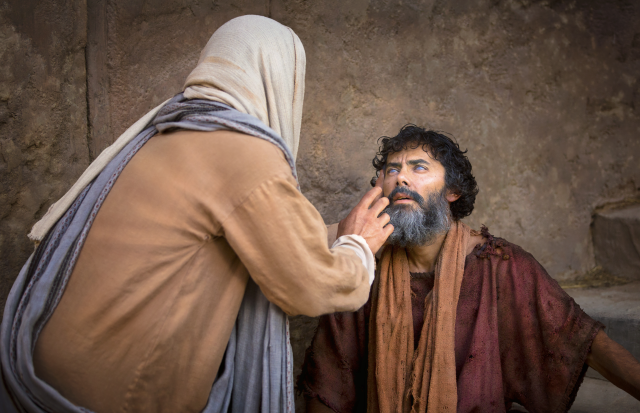
For me, the miracles of Jesus really resonates. I mean, Jesus touched a blind man's eyes, and then he was healed. If I were alive during that time, Jesus could touch my eyes, and I'd be cured. In fact, I long for the day where I no longer have to wear glasses ... one of my deepest desires ... to see clearly unaided and without pain, to take in the full beauty of the world around me, and never be blind again.

But then again, in my current state, would I actually go up to Jesus to be healed? Now that you got that one selfish deepest desire in mind, would you be first in line to have Jesus fix what ails you?

Think about it.

I know that even with the pain I go through every day, I know there are others who are far worse than I am. My eyes aren't that bad ... I can wear glasses with a prescription that cancels out all adverse effects, and I really can see clearly (except for the scratches, and the glare, and now my early cataracts that make rainbow colors around lights at night, and then when my eyes change and -- oh there I go again). But there are others suffering from far more painful maladies. Some are entirely blind. Some are deaf -- I'm reminded of one of Beethoven's famous letters about his selfish deepest desire. Some can't walk. Some have terminal diseases.

I could in no good conscious be the first person to be healed by Jesus -- partly because I have a remedy -- and those guys need the healing a lot more than I do. But still, I would really, really, really love to be healed. If Jesus were to walk directly up to me and say he was going to fix my eyes, I would not say no.

But still, I'm wondering: why can't I get healed right now? What good was all that healing of the sick when we got people today who could use that healing? Maybe it's just me sour-graping things.

Yet, Jesus isn't the only one capable of healing the sick. His apostles could do it. In my own church, it's said that Joseph Smith did it, and there are some accounts of of more modern day church leaders who have been reported to heal the blind.

In fact we are taught that all of us who hold the Priesthood have the exact same healing powers. Plus, there is this in D&C 84:65-73:
And these signs shall follow them that believe. In my name they shall do many wonderful works; in my name they shall cast out devils; in my name they shall heal the sick; in my name they shall open the eyes of the blind, and unstop the ears of the deaf; and the tongue of the dumb shall speak; and if any man shall administer poison unto them, it shall not hurt them; and the poison of a serpent shall not have power to harm them. But a commandment I give unto them, that they shall not boast themselves of these things, neither speak them before the world; for these things are given unto you for your profit and for salvation.
So, why can't I go up to my bishop and say, "Heal my eyes"? 

Well, I suppose any of us could do this, but who has enough faith to heal, or enough faith to be healed? That could be a topic in and of itself. I know Jesus could heal me, but it's difficult to have enough faith in someone like me doing it.

Then again, I've seen and have been a part of several miracle healings. As a missionary, I developed an anomaly in my eye that we all thought was going to be permanent, and after I got a blessing for the sick, it miraculously healed itself at the same moment I went to see the doctor. He was amazed, and so was I.

And again - again, I feel that I was given this malady to give me experience. To help me constantly think about "seeing" all the time, perhaps it has made me a lot more sensitive in seeing things that other people don't. I can evidently hear things that other people can't, and I notice a lot more than other people do about surroundings -- kind of like Monk or Sherlock Holmes. ... And did I just now bring this back to the allegorical meaning of my title?

Anyway ... thanks for letting me whinge away. In the end, all these experiences help to increase our character, and give us more perspective. I ought to be thankful, but I wouldn't mind to be healed nonetheless.