Sunday, October 25, 2020

Warnings From Jesus


During this pandemic, my local church holds these priesthood Zoom meetings twice a month. Every now and then, the lesson makes it here to these weekly spiritual thoughts, and evidently today is one of those days.

Around A.D. 60, the Jewish people in Jerusalem were not happy. As contention increased, they rose up -- first in smaller rebellions, and then in bigger ones. As a result, the Romans came in en force and put a rest to the rebellion, destroying the temple, and killing more than a million Jews, and capturing 100,000.

However, according to Josephus' account, there is no mention of Christians perishing in these attacks. How did they escape? Readers of the New Testament may already know the answer -- they were warned by Jesus. He spelled out the signs, and the Christians saw them and knew what to do to avoid capture and death.

This article explores the whole idea of Jesus preparing his people for the upcoming Roman siege:


I strongly recommend reading that article, and then come back here, because think on this: If Jesus felt it was important to warn the Christians for an event that would occur more than 30 years later, then why is it that the leaders of my church felt it necessary to give us the most political "talking to" I've ever seen my whole life at a General Conference?

For those who don't know my church, we have worldwide conferences twice a year -- usually 5 sessions of two hours each over one weekend. I listened to 4 of those sessions three weeks ago, and practically every talk was about current events ... riots, plagues, contention, racism, and so on. That was eight hours of warning and guidance on how to survive times like these.

Further, in our bi-monthly priesthood meetings, we go over talks in the most recent conference ... meaning we're going to be discussing these topics for another 5 months before the next conference in April begins.

It's funny ... my wife asked how I felt to have the same lesson two times in a row, and I answered, "We got a whole lot more coming!"

The last meeting two weeks ago was on "Love Your Enemies" by Dallin H. Oaks. This week, we took on the same talk, but explored different aspects ... how to avoid contention, and how to recognize warnings from the Lord.

Our instructor took on some pretty heavy topics, and did a good job discussing it while at the same time keeping us from delving into divisive political talk. I don't think anyone said "Trump" or "Biden" at all, and it was pretty nice.

But for today, I'm focusing just on the warning aspect. Because, I think it ominous that our leaders (who I believe to be inspired by the Lord), showed enough concern to give us some pretty scary advice. 

Elder Oaks' talk seems more geared toward avoiding what may come next. Even before Trump became president, I had been complaining about how much we were divided, and we were increasingly becoming so. It only seems to get worse and worse every year that progresses -- so much so that I no longer refuse to take a side -- I am now "unaffiliated." And this year has been particularly bad. People are becoming increasingly more polarized, and much less willing to have good open discussions with each other.

There is no more a desire to work things out, but rather to work to remove opponents from power, to lob insults and disrespect, and to say their opponents are completely wrong and the sole cause of today's ills.

There is only one outcome to such a trend. Just as the Jews let contentions build up, and riled up the Romans, I think on our current path there is no way for us to avoid the strangest civil war we've ever seen and it could get ugly. Millions of deaths? I hope not.

If members of the church were to wake up and start to work toward diffusing this growing toxic situation, we might be able to avoid this internal war, and get back to working together as strong American citizens. But maybe it won't be enough. There were several talks on how to survive in situations beyond your control, and that scares me. Perhaps we're already doomed.

But yet the message was clear from many of the talks in aggregate: if you're prepared, you will fare well. Just as Jesus provided instruction to the early Christians to avoid and/or survive the Roman siege, the Lord may be giving us instruction now on how to avoid and/or survive the upcoming difficult times.

We may not be able to stop what's coming, but we can at least be prepared.

Sunday, October 18, 2020

And the Eyes of the Blind Shall See


Today I've decided that I want to reveal one of my selfish deepest desires. I realize the title that I've picked is usually used in allegory, but today I'm actually talking about the physical action of healing the blind.

I've always had bad eyes. I'm severely myopic (near sighted), meaning everything I see is out of focus, and I also have an annoying stigmatism that kind of shifts the horizontal and the vertical. Plus, in recent years I've started the early stages of cataracts in both eyes.

I hate glasses, but I can't do without them. Yet, they come with their own issues. Scratches are annoying. In fact I saw some fresh new scratches on my glasses this morning, which helped me to choose today's topic. It's so demoralizing to realize that each scratch is permanent until I get my next pair -- but then how soon will those get scratched? It never ends!

Since my prescription is so heavy, I'm forced to get the high index lenses, which really messes with the brain and gives me headaches. And still, the weight pushes down on my ears, often causing sores and more headaches, and even the nose gets sore, and sometime my cheeks under the lenses. We glasses wearers quickly recognize our own when we see the nearly permanent dents just above the nose.

I once tried contacts, but my wimpy eyes can't handle them ... you can ask my high-school friends who went down with me to Panama City. The contacts were a disaster. But man was I cool for a few days!

I know ... a lot of whinging going on, but I'm getting there. I'm going to pause for a moment and let you think of your own selfish deepest desire. We all got something ... that one thing that's annoyed you your entire life that you feel you can do nothing about. (Okay ... something else besides Mel.)

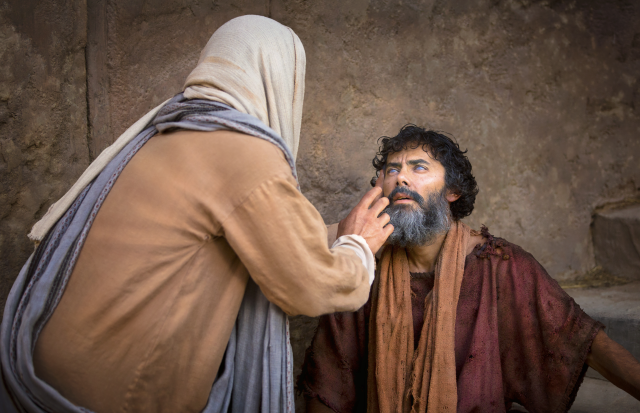
For me, the miracles of Jesus really resonates. I mean, Jesus touched a blind man's eyes, and then he was healed. If I were alive during that time, Jesus could touch my eyes, and I'd be cured. In fact, I long for the day where I no longer have to wear glasses ... one of my deepest desires ... to see clearly unaided and without pain, to take in the full beauty of the world around me, and never be blind again.

But then again, in my current state, would I actually go up to Jesus to be healed? Now that you got that one selfish deepest desire in mind, would you be first in line to have Jesus fix what ails you?

Think about it.

I know that even with the pain I go through every day, I know there are others who are far worse than I am. My eyes aren't that bad ... I can wear glasses with a prescription that cancels out all adverse effects, and I really can see clearly (except for the scratches, and the glare, and now my early cataracts that make rainbow colors around lights at night, and then when my eyes change and -- oh there I go again). But there are others suffering from far more painful maladies. Some are entirely blind. Some are deaf -- I'm reminded of one of Beethoven's famous letters about his selfish deepest desire. Some can't walk. Some have terminal diseases.

I could in no good conscious be the first person to be healed by Jesus -- partly because I have a remedy -- and those guys need the healing a lot more than I do. But still, I would really, really, really love to be healed. If Jesus were to walk directly up to me and say he was going to fix my eyes, I would not say no.

But still, I'm wondering: why can't I get healed right now? What good was all that healing of the sick when we got people today who could use that healing? Maybe it's just me sour-graping things.

Yet, Jesus isn't the only one capable of healing the sick. His apostles could do it. In my own church, it's said that Joseph Smith did it, and there are some accounts of of more modern day church leaders who have been reported to heal the blind.

In fact we are taught that all of us who hold the Priesthood have the exact same healing powers. Plus, there is this in D&C 84:65-73:
And these signs shall follow them that believe. In my name they shall do many wonderful works; in my name they shall cast out devils; in my name they shall heal the sick; in my name they shall open the eyes of the blind, and unstop the ears of the deaf; and the tongue of the dumb shall speak; and if any man shall administer poison unto them, it shall not hurt them; and the poison of a serpent shall not have power to harm them. But a commandment I give unto them, that they shall not boast themselves of these things, neither speak them before the world; for these things are given unto you for your profit and for salvation.
So, why can't I go up to my bishop and say, "Heal my eyes"? 

Well, I suppose any of us could do this, but who has enough faith to heal, or enough faith to be healed? That could be a topic in and of itself. I know Jesus could heal me, but it's difficult to have enough faith in someone like me doing it.

Then again, I've seen and have been a part of several miracle healings. As a missionary, I developed an anomaly in my eye that we all thought was going to be permanent, and after I got a blessing for the sick, it miraculously healed itself at the same moment I went to see the doctor. He was amazed, and so was I.

And again - again, I feel that I was given this malady to give me experience. To help me constantly think about "seeing" all the time, perhaps it has made me a lot more sensitive in seeing things that other people don't. I can evidently hear things that other people can't, and I notice a lot more than other people do about surroundings -- kind of like Monk or Sherlock Holmes. ... And did I just now bring this back to the allegorical meaning of my title?

Anyway ... thanks for letting me whinge away. In the end, all these experiences help to increase our character, and give us more perspective. I ought to be thankful, but I wouldn't mind to be healed nonetheless.

Sunday, October 11, 2020

Love Your Enemies


Last week I mentioned that my church held the most political conference I've ever seen. Our church leaders seem to be very concerned with the level of anger rising in our nation, and they gave us several talks touching on this anger, because they believe that we need to hear it at this particular time.

Today in our Zoom church meeting, we discussed one of these talks entitled, "Love Your Enemies."

For those of you who care to watch the talk, here is the full version. It's originally meant for Mormons in the USA, but the concepts are universally Christian. (Watching the video is not required for continuing to read this post.)


The main scripture comes from Jesus in Matthew 5:43-44:
43 Ye have heard that it hath been said, Thou shalt love thy neighbour, and hate thine enemy.

44 But I say unto you, Love your enemies, bless them that curse you, do good to them that hate you, and pray for them which despitefully use you, and persecute you;
And we heard this scripture at least three if not more times throughout the whole conference. The solution to the anger plaguing our nation now? Love. Or perhaps in less religious terms: Respect.

The first thing to realize is that it's okay to disagree. The scriptures says contention is of the devil, but disagreement in and of itself is not contention. Rather, contention rises from how people choose to handle those disagreements. Having disagreements just rises naturally from thinking differently and seeing the world through different lenses.

But how exactly does one disagree without "contending"?

I've struggled with that question my entire life, as I am a very opinionated dude. I love a great discussion, especially when there are opposing viewpoints. A good argument may be one of the best ways to exercise the brain and test skills of logic, and so on. And an argument, in the technical sense, has no need of being contentious. The latter only comes when an argument turns into something personal.

So, throughout my life I've sought to participate in engaging arguments, trying to toe the line where we hold respect for each other, and learn things in the end. But more often than not, I'll touch a nerve, or someone will touch one of my nerves, and then anger ensues, and it turns into a nonproductive brawl. 

Once or twice, I've even had someone de-friend me on Facebook -- kind of a drastic measure for just having a conversation. And once I had a bunch of actuaries team up on me in a forum to let me know that I was at a level of stupid that they had ever seen and how I just needed to leave the discussion. (Though in that last case I did have some other actuaries reach out to me in PMs to give me support -- they just didn't want to do it in public.)

So, being argumentative, though lots of fun to me, has its costs. I think that in all cases it went bad, I made mistakes -- it only takes one small one to blow everything up, and then I'm the bad guy. But with every mistake I learn how to handle it better the next time. At least I hope that I have gotten better.

The key? It really is Love and/or Respect. If you have no intention of understanding your opponent's way of thinking, then it's probably best not to even engage in discussion. 

For example, when it comes to Trump vs. Biden, I believe that I understand almost all of the arguments as to why people prefer one over the other. I prefer one candidate, but I also fully understand why people like the other one, and I'm perfectly fine with that. This one is a debate best settled by voting, and not anger, riots, and unproductive contention.

I am also very willing to change my views, as I'm a big proponent of the scientific method (which is showcased in Alma 32). As an opinionated dude, I do indeed have a very strong "null hypothesis" belief system. Locking this puppy down gives me a strong sense of perspective, to which I judge everything I see in the world. But every day I see things that challenge my belief system -- little tiny "alternative hypotheses" that I go and research, and every day I will accept several of them and update my belief system. I think everyone could benefit from this same approach to life and there would be a lot less anger in the world.

If you love/respect your opponents, then you may find that you can have engaging conversations. Even if you don't persuade them to change their views, you can end up learning each other's views and have better perspective. Sometimes it can help you to have a better understanding of why you are "right." Or maybe you can gain a better appreciation for your "enemy."

Either way, it seems that Jesus has laid out the path to avoiding contention. We don't need to remain silent, but we do need to Love, and that is such a simple concept. 

What can you do to love your "enemies"?

Sunday, October 4, 2020

Conference Report - Oct 2020

For this week's spiritual thought, I'll give a quick report from my church's October General Conference, which ended about 10 minutes ago from the time I started writing. For those of you not familiar with these conferences, we hold these twice a year ... first Sunday in April and first Sunday in October. Usually these are held in the Conference Center in Salt Lake City and broadcast throughout the world simultaneously (complete with language translations and sign languaging, too).

This is the second session impacted by COVID-19. Usually these conferences attract thousands of attendees, but this year, both conferences were held in a small room with zero attendees, also featuring previously recorded broadcasts of the previously-named Mormon Tabernacle Choir.

This, of all conferences I've witnessed, has been the most political I've ever seen. This is most likely because of the political upheaval the US has suffered throughout this year. Topics included...
  • COVID-19: this has been a source of much tribulation and disruption, whether it be from sickness, death, or cancelled activities and loneliness. Most of the talks that touched on this centered around the ideas that we're being tested, we're becoming stronger through tribulation, we're receiving opportunities to serve others in their times of need, we're having more opportunities to worship at home with the help of "Come Follow Me," and some families are becoming closer to God. One talk (Elder Holland?) came very close to what I wanted to hear ... that we should follow the promptings of our governments and work together to shorten the duration -- that we're being tested in our response, but it didn't quite hit. Instead, most of the talks seemed to treat COVID-19 as something we can't do much about, like a flood, or fires. 
  • Racism: in light of recent happenings, it was made clear several times that we are all equal, regardless of the color of our skin. Racism against black people is real and we should take steps to continue eradicating it. And also racism against Asians, Mexicans, and other races.
  • Peaceful protests: It is more than appropriate to hold peaceful protests -- in the first session, somebody also said that we should not take away the right to peacefully protest.
  • Violent protests: In the US it is inappropriate to have violent protests, as we have avenues to peacefully influence laws and change things peacefully.
  • The election: We must have an unencumbered voting process, we must peacefully accept the results, and we must have a peaceful transition (if needed).
  • The Constitution: It was inspired by God by imperfect people, but it has provided us with the freedoms that we enjoy, and we should strive to maintain the Constitution and its freedoms.
And then there were the big topics that were repeated several times in conjunction with everything above:
  • We must have patience. God allows tribulations for our own good, and with patience, we come out stronger and more experienced.
  • Love one another. Recent events have deepened the divide of our nation greatly. We must learn to "love our enemy" and those who "despitefully use us." We are in desperate need of healing and renewed unity. Loving is the greatest commandment, and as we exhibit it, people will listen to us and we can then begin to work together.
  • Remember God and turn to Him. Even though the world has changed, our relationship with God should remain the same. We can still offer up our prayers. We can still go back to church (when possible). We can listen to the answers to our prayers even if we don't like the answers or the timing.
Overall, it seems the leaders of our church are very concerned with all the negativity hitting us, and the negativity we've been exhibiting toward each other.

The message that I got specific to me: It's okay for me to voice my opinions and participate in all the political discussions, but I must remember to love everyone ... don't get angry, and respect everyone's opinions.

As for COVID-19, specifically, where I'm most frustrated, I need to let go the anger and frustration ... though, I'm not sure how to do that yet. I could be nicer toward people. Or in my presentations, I could be a little less emotional, and stick more to presentation of the facts and helpful tips. I do want to help save lives, and I do want us to get back to normal as quickly as possible -- and though I know how to get there, I need to remember to have patience with all my friends. Be happy. Love the life that I have. Do the best I can do, personally, and keep on looking toward the time when we all come out of this stronger and wiser.

What did you get out of Conference?

Sunday, September 27, 2020

We Are All Children


One thing I've learned growing up ... is that we don't really grow up. Well, we do learn things, gain experience, and become wiser and much more capable, but we all still have imperfections, insecurities, and ignorance.

And when I say "ignorance," I'm meaning in a good sense -- simply not knowing something. There are so many things to know in the world that it's impossible to know everything, and so we must rely on other people who are experts. Like a couple of weeks my lawn mower broke down. I did everything in my power to fix it, but it wasn't enough. I had to take it to a mechanic ... it turned out to be a clogged carburetor. The guy got paid, and everyone was happy. 

I could write a whole post on ignorance, but I'll continue on with this child idea.

I look at myself as a child, and there were some things I did well. I was always good at music ... a little prodigy. There were things I enjoyed ... TV and video games. Also math and logic puzzles. And I had a vivid imagination. I'm sure we all have lists of things we were good at as a child.

I also had a whole bunch of insecurities. I was kind of okay making friends, but I was always a cut-up, always looking for attention, and not really connecting with many people. People liked me, but always saw me as goofy, or someone to make fun of, or to go to for a good joke.

And I was always afraid to go somewhere new, to call someone on the phone, or go up to someone to engage. I hated doing the door-to-door sales many schools had you do for fundraising. My parents also pointed out to me many times that I spent too many times reading books instead of playing with friends.

As a child, I always looked up to adults -- how they had it all together. They were wise, and I could trust them. They were grown up. I longed for the day to come when, I, myself would be grown.

When I finally did grow up, I found that hardly anything changed. My body was larger and stronger, but other than that, my strengths were still my strengths, and my weaknesses were still my weaknesses. Of course I learned how to capitalize on my strengths, but I was already doing that as a child.

And I look at all the other grown ups around me, and I can see the same in them. They all still have insecurities. That's one thing my age and experience has granted me ... the ability to see these insecurities in everyone. Even when I look at famous people -- presidents, CEOs, religious leaders ... I can still see the same insecurities even through the facade each of these people put up.

So, I totally get it when Jesus tells us to be like little children.
Verily I say unto you, Except ye be converted, and become as little children, ye shall not enter into the kingdom of heaven. (Matthew 18:3)
Understanding this has helped me immensely in my adult years. I think it's being honest, knowing my own shortcomings, and realizing that everyone else is in the same boat -- none of us are immune.

And I know that God and Jesus realize that, too. To them, we all really are children.

The most important part ... if we truly are children, then that means we all have potential. There's always room to grow and become bigger than what we were before. So, realizing we are children should constantly remind us that we need to always push ahead and always improve, and never stop. And this is what I believe Jesus is talking about in his quote above. Those who stop trying think they're already there, and are no longer children -- and these types with their arrogance are unlikely to progress any further.

So who's with me! Who wants to keep on being a child?

Sunday, September 20, 2020

Jesus is the Cornerstone


As I am resuming activity in this blog, I must remind myself of my intended audience. Most of my friends do not belong to my church. Many are Christian or Jewish, a couple are Muslim and other religions, and several are agnostic. But one thing my friends all have in common: they are not afraid to ask me questions about my religion.

I figure that if you're here, you have curiosity, and you are more than welcome -- I, myself, love to learn about just anything. Sometimes I write to just my Mormon peeps, and sometimes I take time to explain some of the more basic principles -- which can even be good reminders for strong members of the Church as well.

Also, this year, our church, worldwide, is on a reading schedule ... every week we read a selection of the Book of Mormon, and by the end of the year we will have read all the way through. Our Church started this new program last year with the New Testament. Next year we'll read the Doctrine & Covenants (lots of Church history). And the year after that is most likely the Old Testament.

I'd like to emphasize that this week's reading is about the most important event of the whole Book of Mormon: Jesus' visit to the Nephites / Lamanites on the American continent. This time I caught a different angle that I'd like to share today.

At the beginning of the Book of Mormon, Lehi and his family left Jerusalem and sail to the Americas. Along the way, for whatever reason, Lehi and his son, Nephi, received a revelation that the Son of God would be born 600 years in the future. And during the next 600 years, there were several revelations, similar to Isaiah, but with much more precise information. Jesus Christ would be born in Jerusalem, and he would die to save us from our sins.

The faithful always believed this would happen, but many did not. These unbelievers would say, "There's no way you can know this Savior is coming." Or "What is that to us? He's going to be in Jerusalem, not here."

It's easy to imagine the skepticism. "You just made this all up to create a church to control us. 600 years is a long way away, so there's no way to prove your prophecies. Your church is 'safe.' And when 600 years comes and we don't see him, you're just going to say you had a revelation that he was born and that he's already died, and we'll never know because we're over here."

As I discussed last week, there were signs given prior to Jesus' birth. Samuel the Lamanite said in 5 years a night would be as day, and a new star would appear. And then at Jesus' death there would be darkness for 3 days straight.

When the new star appeared, there was a short period of repentance and peace, but then most of the people went back to being wicked, even saying that the new star was a trick of sorcery. During the next couple of decades, there was lots of death and more wickedness.

Then in 33 AD, the sign of the death occurred. There were 3 days of darkness, such that no light could penetrate. Earthquakes changed the land and killed many people. During these 3 days, those who were spared had to endure darkness, uncertainty, remorse, and pain. And then something happened that no one knew was coming.

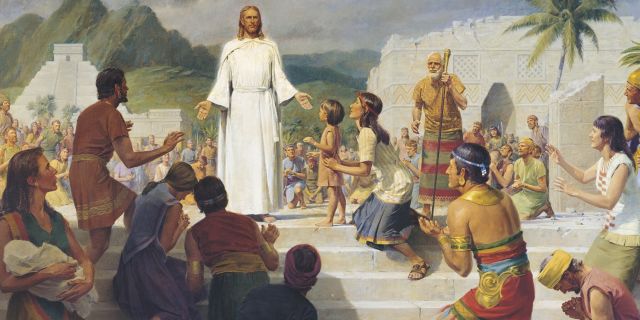
Jesus, himself, appeared to them, during his 40-day ministry on earth following his resurrection. At first it was just a voice in the darkness, giving the survivors comfort. And then after an announcement from the Father, Jesus descended from the skies and landed among the people. He then ministered unto them, explaining who he was, healing the sick, giving blessings, and so on. (3 Nephi 8-11)

And I don't know why I always seemed to miss this before. The people who believed in Jesus prior to his coming to earth had no idea that He, himself, would visit them in person. As far as they knew, he would only be in Jerusalem, and not anywhere near them. So great is His love for all of us!

In later readings, Jesus will tell the people that he needs to go and visit other sheep that are not of his fold. Which all emphasizes the center of every Christian denomination: Jesus is the one and only Cornerstone of the Church. He is the reason for everything. Without his sacrifice, our sins would make us unworthy to return back to heaven. His teachings help us to become more like him and become better people. And most importantly, he's not just for the Jewish people he lived with during his mortal existence, but he reaches out to all of us, regardless of our position, heritage, or even our beliefs.

Even if our several denominations disagree on certain characteristics of Jesus and other points of doctrine, this is the one aspect of Christianity where we are all united. Jesus is the one way for us to proceed and return to heaven. And he invites all of us to come unto Him.

Edit - 1:45PM: It looks like I did miss a prophecy in there. Alma 16:20 says (around 78 BC): "And many of the people did inquire concerning the place where the Son of God should come; and they were taught that he would appear unto them after his resurrection; and this the people did hear with great joy and gladness." 

Further, 3 Nephi 11:12 (back to 33 AD) says: "... the whole multitude fell to the earth; for they remembered that it had been prophesied among them that Christ should show himself unto them after his ascension into heaven."

So, it seems the prophecy was known to the people, but it seems to have only come back to memory after Jesus had shown himself.

BTW, I found this great classic video depicting Jesus' visit -- very touching, and makes me want to have been there.

Saturday, September 19, 2020

Is Trump Chosen By God?


If you've been following my recent posts in my other blogs, you'll probably already know that Trump is not my favorite president. Yes, I'm biased, but I would yet like to explore this question: Is it possible that Trump has been chosen by God?

Another quick disclaimer: the main audience of this post are the members of my church (Church of Jesus Christ of Latter-day Saints). The others of you are free to read along, but for this post I'm going to assume the readers already have a working understanding of my religion.

It's very clear that many Christians love Trump, as evidenced in the picture up top. Maybe this is because he's been mostly positive toward the Judeo-Christian religions. He's the very first president to visit the Wailing Wall in Jerusalem while in office. He has talked up religious freedoms. He has even reached out to Utah and our church members.

So, it can seem that Trump, though imperfect he is, was chosen by God in order to strengthen Christianity in general and help us all come closer to God. And I've had several indicate this to me on social media, concerned that my vote for Biden may usher in a wave of socialism that would destroy our Constitution, and fall under the devil's wishes.

First off, we should explore the question: "Does God even choose political leaders to lead us?"

Some people use Romans 13:1 to say that every single government leader in the world is chosen by God.
Let every soul be subject unto the higher powers. For there is no power but of God: the powers that be are ordained of God.
A literal reading of this would have us believe that Hitler and Mussolini were chosen by God, as evidenced by the fact that they came into power. However, do any of us believe they were chosen by God? It seems to me that the verse written by Paul is being misinterpreted. Also, it wouldn't answer the original question, as Trump becomes no more special than any other leader ... (just like every month at Benihana is Manager Treat Month -- some of you will get this one -- "It's my treat").

If we include the Book of Mormon and D&C, I think we get a fuller picture on how God intends for our leaders to be chosen. Consider the following scriptures:

D&C 98:7-10
7 And as pertaining to law of man, whatsoever is more or less than this, cometh of evil.
8 I, the Lord God, make you free, therefore ye are free indeed; and the law also maketh you free.
9 Nevertheless, when the wicked rule the people mourn.
10 Wherefore, honest men and wise men should be sought for diligently, and good men and wise men ye should observe to uphold; otherwise whatsoever is less than these cometh of evil.

Mosiah 29:25-26
25 Therefore, choose you by the voice of this people, judges, that ye may be judged according to the laws which have been given you by our fathers, which are correct, and which were given them by the hand of the Lord. 
26 Now it is not common that the voice of the people desireth anything contrary to that which is right; but it is common for the lesser part of the people to desire that which is not right; therefore this shall ye observe and make it your law—to do your business by the voice of the people. 
It seems clear to me from these verses that God intends for us to choose our own leaders. This is why our Constitution was formed, so that we can have the freedom to choose. And not only that, we can also be held accountable for our choices. If we choose a wise leader, we prosper; and if we choose a wicked leader ... Mosiah 29:27
27 And if the time comes that the voice of the people doth choose iniquity, then is the time that the judgments of God will come upon you; yea, then is the time he will visit you with great destruction even as he has hitherto visited this land.
In other words, I believe that God has allowed us, in the extension of the free will that we enjoy, to have full stewardship over the people we choose to lead us. So, God doesn't choose our president; we do.

Also consider from the New Testament when Jesus was asked about paying taxes. In Matthew 22:21, he answered: "Render therefore unto Caesar the things which are Caesar's; and unto God the things that are God's."

It already seems pretty clear ... the concept of the separation of church and state established millennia before the United States were formed. And again it appears that we have full reign on how we choose our leaders.

So, did God choose Trump, or Obama, or Reagan for that matter? The answer seems clear: No, he did not.

Every election cycle, our church puts out a statement to remind us ... the choice is ours. And almost always, they will include that bit from D&C 98:10 and paraphrase it like this: "Latter-day Saints as citizens are to seek out and then uphold leaders who will act with integrity and are wise, good, and honest."

Here's a sample statement. 

Though, if you compare with the 2016 statement, that phrase was replaced with: "Principles compatible with the gospel may be found in various political parties, and members should seek candidates who best embody those principles." A funny playing down of the "wise, good, and honest" bit!

Coming back to the our current president, I know that some of you reading this have problems with Trump, but you voted for him anyway, which is more than okay. It's your right to vote. Some vote solely on policy and not the character of the candidate.

If you look at recent Utah voting history, Trump was voted in with the smallest of margins, winning only 45.5% of the vote compared with the next lowest of 62.6% for Bush Sr. in 1988. So, I know he isn't necessarily your most favorite conservative pick.

I, personally, have my own problems with Trump and the policies and actions he's taken in relation to the coronavirus, and everything else. I also do not think Trump is "wise, good, and honest." I do not think he exhibits the traits of leadership we're all taught in Sunday School. He isn't humble, nor compassionate to all of his constituents. And I think he is by far the most divisive president I've ever seen during my lifetime. But that's just me.

To end my post, I will try to leave you with something positive. 

Why in the world am I voting for Biden? Why not some 3rd party, like I did in 2016? Because ... something caught me off guard.

On the night of Super Tuesday, I decided to watch the celebratory speeches of Sanders and Biden. Sanders came first. And it was pure fire. It was scary. He was talking about how he was going to go after everyone and punish everyone. He wasn't humble. And even after losing so many states he talked about how he was still going to win and show Trump and the Republicans. I would actually prefer Trump over him.

And then I heard Biden, and it was like night and day. I saw humility. I saw energy, and I saw true concern and compassion toward ... everyone. He talked about how he was going to unite and heal the nation, and it hit me. This is exactly what our nation needs now. After years of divisive rhetoric, we need desperately to work together. And I think Biden could actually pull it off. Here's his speech if you feel so inclined to watch ...

https://www.youtube.com/watch?v=YnE9kKeOyTg

So, give it all good thought. Who do you want to lead this country the next 4 years? It's not God's choice, as it's a decision he has given to us so we can practice our free agency. Whoever gets the most electoral votes will be our next president. The best you can do is vote, and do it proudly. Go and vote according to your conscious, and we'll see how it all comes out in the end.