If everyone in the world were to follow this one principle (listening), it would solve nearly every problem.
Doesn't it make sense that when you listen, you'll learn more, understand more, and will be able to make better decisions? And isn't it amazing how most people refuse to do it?
This concept is so important that it makes up the most of Stephen Covey's 5th habit: "Seek first to understand, then to be understood."
How exactly does this work? The Self Reliance lesson manual provides the following 4-step process.
1. Concentrate: pay attention to the words and body language, and avoid distractions.
2. Appreciate: look at the speaker, show interest, and express thanks.
3. Review: try to repeat what you just heard.
4. Ask: "Did I understand?" and listen to the answer.
I got to practice some of this, myself, this past year. Even though I had planned certain activities in my music business, I came across a comment that someone made: "It's very difficult to buy sheet music when you can't see what's inside." After asking follow-up questions, I then decided to introduce free choral previews on my website, which appears to have been well received, even though I ended up putting off other business activities for a month. In the end, it appears to have been worth the effort.
Think what could be accomplished in Congress if Democrats and Republicans were to simply listen to each other. How many times have you heard someone from one party complaining about how the other party is stupid and doesn't listen, when in reality it turns out that the person complaining isn't listening either?
The lesson manual also spends a considerable amount of time relating this principle to prayer. It is all too easy to go to our knees, thank God, and ask for things. However, how often do we stop to listen to the answers?
This part is very difficult for me. Very often when I say a prayer, it's usually too noisy, or I'm distracted with something else. Yet there are other times when I find myself ready to listen and I'll receive the answers I need to hear.
The 4 steps above can mostly be applied to prayer as well. There is no "body language" or being able to "look at the speaker," but most everything else applies. God isn't some out-of-reach super-duper-uber-high entity who couldn't care less about our everyday lives. Rather, he has shown over and over that he wishes to talk to us, and all we have to do is to simply listen.
So, give it a try. Over the next week, whomever you run into, listen to what they have to say and seek to understand them. See how they respond when they realize you had been listening. And see what you can learn.
The 10th principle of self reliance may be one of the toughest ones to practice: showing integrity. This is most difficult when being tempted to cheat a little or break some small rule when you think you won't get caught or if you think it's not that important.
Examples may include telling a white lie, claiming tax deductions you don't really qualify for, failing to disclose any problems with a product you're selling, keeping change when a cashier gives too much back, driving over the speed limit or even cutting through a parking lot.
I know ... no one's perfect, and going a few miles over the speed limit isn't going to keep anyone from going to heaven, but we could at least try -- at least where it really counts.
Consider the following story as told by Elder Robert C. Gay during the October 2012 General Conference.
I wonder--how many of you readers have told the movie ticket taker that your 12-year-old child was 11, just to get a cheaper ticket? I've done it, myself, multiple times, especially when we were low on cash. As an expert on financial matters, it is very easy for me to rationalize why this would be okay. Are you ready for this?
Why do movie theaters sell children tickets for cheaper? Because of supply/demand concerns, and also as an incentive to bring more families through the doors. If child ticket prices are too expensive, the adult parents, themselves, will decide not to come watch the movie. Providing cheaper tickets for children actually results in more money coming into the theater.
And when my child just turned 12 years old, she wasn't much different than she was a week prior when she was 11. And we, as a family, were still struggling. Thus the theater would be more than happy to let my child continue to come in cheaper so that they would continue to get revenue from the whole family.
See how easy that was? That's called rationalization, and we all do it every single day. It sounds good and it makes us feel a whole lot better about bending the rules, but when does it ever make it right? And if we're willing to bend a little here and there, where else are we willing to bend?
A couple of decades ago, I used to work at McDonald's, and back then, their training was specific with uniform unbending rules. In particular, I was taught how many pickles were to go on each product. Hamburgers and cheeseburgers get one pickle. Big Macs, double cheeseburgers, and bigger sandwiches get two.
I still eat at McDonald's; I've never outgrown the taste. But I will always check how many pickles I receive. If I get extra pickles, others might say, "Hooray, extra pickles!" But I can't help thinking, "If they're breaking this one rule, what else are they bending? Are they cooking the burgers the full amount? Are they resisting the temptation to drop two baskets of fries at the same time (leading to lower temperatures and undercooked fries)? Are they cleaning their dishes properly and cleaning out the grease on schedule? What about the dining area and the bathrooms?"
The wrong number of pickles signals to me possible reasons to avoid that one particular store, as there are usually plenty of them around to choose from.
And that's a lesson I learned early in life. Sure, I'm not perfect, and I will bend the rules daily, but I also know how damaging it can be when I do get caught. When I fail to do as promised, people will say, "I can't count on Mel." When I drive like a maniac and cut off someone at church, they'll remember it for years. When I pull too many pranks, they'll say, "I can't trust him."
Ultimately, that's why we all need to practice integrity, because it is of utmost importance to gain the trust of people we're dealing with. Especially in business. The more you treat people with respect and fulfill their expectations, the more they return for your services.
Finally, to end on a spiritual note, I'll provide this quote from the late Elder Wirthlin from the April 1990 General Conference.
Integrity means always doing what is right and good, regardless of the immediate consequences. It means being righteous from the very depth of our soul, not only in our actions but, more importantly, in our thoughts and in our hearts. ... A little lying, a little cheating, or taking a little unfair advantage are not acceptable to the Lord. ... The consummate reward of integrity is the constant companionship of the Holy Ghost, ... [who will] guide us in all we do.
The next principle (#9) of Self Reliance looks like another lesson from The 7 Habits of Highly Effective People. If you want to get where you want to go, you must first figure out where you want to go, and then figure out how to get there.
First, it helps to formulate a life's mission. What are your desires? What would you like to accomplish? When you come to the end of your life, what would you like to see when you look back, such that you will be able to say, "I had a good life"?
I know. It sounds corny, but it doesn't need to be anything fancy -- just anything you want to write down. It can be changed at any time.
For me, it's to maximize my music and fiction output so as to become a good influence in other people's lives.
Next, you must set goals to help you carry out the life's mission. These can be large goals, small goals, or sub-goals, or even goals of tangental things you want to accomplish, even if it doesn't directly relate to your life's mission.
The Self Reliance lesson manual lists 5 characteristics of a good goal:
#1) Specific and measurable.
#2) Written down and displayed.
#3) Have completion times.
#4) Require specific actions to accomplish.
#5) Constantly reviewed and updated.
My life coach gives another set of 5 characteristics that are very similar. Perhaps you'll like this list better:
Specific Measurable Action Oriented Realistic Time Based
With this in mind, an incomplete goal would be: "I want to lose weight." Without specific numbers in mind, you probably won't lose much weight.
A better, but still incomplete goal would be: "I want to lose 20 pounds." Without a time limit, you could be on this diet forever, get frustrated, and stop.
A bad goal would be: "I want to lose 20 pounds in 1 week," as it is unrealistic.
A perfect goal would be: "I want to lose 20 pounds in 4 months." This goal is specific, measurable, actionable, realistic, and time bound. If you write it down and constantly review and update as needed, then you're well on your way.
Finally, the manual suggests finding a mentor to help keep you in line. This is exactly what I had decided to do about three years ago. I found and hired a life coach, and he helped me to align my priorities. It's helped me to start my own business and to push forward in growing that business. It's helped me to reach out to colleagues and learn valuable information.
As a result, I am now much closer to carrying out my life's mission. I still meet with my life coach, as there's still a long way to go.
So, if you want fulfillment in this life -- figure out how to get there. Do the necessary research. Learn what you have to do. Enlist friends and colleagues to help you in your quest. And never give up!
Self reliance is a way for people like you and me to work together for our mutual benefit. This sounds like one of the core principles from The 7 Habits of Highly Effective People.
Here's how it works.
Let's say someone does a task alone. 1 unit of effort provides 1 unit of results. Another person doing a similar task alone also exerts 1 unit of effort for 1 unit of results. What happens when these two people work together? If each exerts 1 unit of effort, will it add up to 2 units of results?
Surprisingly, the answer often turns out to be greater than 2. Think about it. If the tasks are similar, then the to-do list can be split between the two workers, and both can receive higher benefits from the same amount of effort. Thus 1 + 1 becomes 3 (averaging 1.5 units of results per person) or even higher.
Stephen Covey, in his book, refers to this as synergy. When two parties listen to each other and determine how each can best contribute, the result can be a deal that benefits both of them greatly, what one would call a win/win situation.
To kick this up a notch, consider this: In life, we are all in different stages. For example, some are mature, capable adults, while others are inexperienced children. Some are financially set for life, while some must beg for each meal. As such, we may often find ourselves to be in a position to help others.
When someone comes to you for help, how do you react? Many of us will say, "These people are lazy. I worked hard to be where I am, and why should I help these people?" When we have this attitude, we may be missing a wonderful opportunity.
Imagine flying on an airplane with your young child. The cabin pressure suddenly drops, and oxygen masks come down. You, being experienced, know enough to put the oxygen mask on, but your child may not know what to do. Would it make sense to leave it to the child to put on his own mask, or would you help him to do the task?
It's similar with those who are in need. They may not know how to be self-reliant, but with a little bit of help, they may be able to get there.
On the airplane, when you put on your child's mask, you are simultaneously teaching him how to do it, preparing him for future similar events.
Also, get this: when the masks come down, do you first put the mask on your child? Or do you put your mask on first before you help your child? If you don't put on your mask first, you could possibly go unconscious before finishing, thus endangering both lives. Likewise with self-reliance, it's difficult to help someone when you are yourself in need.
In May 2012, Elder Robert D. Hales said, "The purpose of both temporal and spiritual self-reliance is to get ourselves on higher ground so that we can lift others in need."
Whatever we learn in life can be passed on to others, and we can help others through our service, while also teaching them how to gain their own self reliance. Often the favor can be returned when we, ourselves, become the ones in need.
Also, service can be a way to help us become closer to the Lord.
Elder Dieter F. Uchtdorf said in May 2011, "Often, the answer to our prayers does not come while we're on our knees but while we're on our feet serving the Lord and serving those around us. Selfless acts of service and consecration refine our spirits, remove the scales from our spiritual eyes, and open the windows of heaven. By becoming the answer to someone's prayer, we often find the answer to our own."
Thus, service becomes a win/win situation to everyone involved. Spiritual synergy is obtained, more people become edified, and are all elevated to higher levels.
So, next time you have an opportunity, try it out. Provide service. Help someone move. Provide a gift. Provide support to those suffering from a disaster. Be a listening ear. And see what blessings will arise and see if everyone is lifted up. See if you can witness firsthand spiritual synergy.
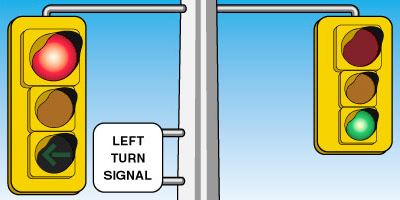
In my city there is a moderately busy intersection. Just as most traffic lights in Winston Salem seem to behave, this one allows left turns only when the left arrow is green (aka a "protected left turn"). When it's a red arrow, you can't turn, even when there is an opening as traffic is flowing straight on both sides. In other words, drivers are not allowed to "yield on green" when turning left.
The problem with this intersection is that most of the time, it would be very easy to turn left on a red arrow, as there are usually many openings. This seems to annoy many people. About 40% of the time that I go through the intersection, I'll see someone cut through the corner parking lot to make the left turn. They do this because they know they can turn left faster than waiting for the light.
For you local folks, I'm specifically talking about driving south on Reynolda Road turning left on Fairlawn Drive.
In many places, cutting through the parking lot is illegal, and it most likely annoys the heck out of the bank and gas station who own the lot. In fact, the increased traffic was enough to create potholes that had to be repaved recently.
Using your problem solving skills, can you think of any good remedies to fix this situation?
One solution implemented years ago: install speed bumps. Yet this does not deter these miscreant left-turners. It's still faster than waiting for the light.
Another more passive solution: educate people how to follow the laws, and then rely on them to make the right choices. (Yeah -- right.)
A couple of times I've seen a police car sitting in the parking lot. Now, this is an interesting solution. I've seen Winston Salem employ this tactic throughout the whole city. What they like to do is to park a random police car in a parking lot. Sometimes there will be someone in it, and sometimes not. I think the idea is that if you see the police car (empty or not), you're going to behave.
But how much does it cost to leave a police car parked in a lot? And how much more would it cost to have someone man the car waiting for left-turning miscreants? And how much crime is being missed because of these efforts?
If only there could be some other solution!
Why I bring up this conundrum: most of the time when a problem arises, more often than not, discussions center around how to deter the miscreants. How can we stop the jerks? How can we punish them?
And more often than not, the true problem is missed entirely. Think about it. If these miscreants are turning left, it's only because they are able to -- safely. This is nothing more than pointing out inefficiencies in the traffic light setup. If left-turns are prohibited during times when they could otherwise be executed safely, the prohibitions are doing nothing more than creating needless congestion and slowing down traffic.
The correct, least-expensive, and most efficient solution to this problem would be to install a yield on green traffic signal at this spot.
Think about it. Once you understand the incentives of the miscreant left-turners, you'll see how this solution could change their behavior. Now, being able to yield on green, it would actually be faster to go up to the light and wait for that safe opening than to cut through the parking lot.
Then, all of a sudden there is no more need of the speed bumps or cops at the corner. Traffic through the lot decreases, cops can spend more time fighting real crime, congestion is lowed, efficiency is gained, and traffic flows more freely. A win-win solution!
Now I challenge you to look around. Look at politics, organizations, and anywhere decisions are made, and notice the stuff that annoys you. I bet you'll find that more often than not, decision makers will put the cop at the corner instead of solving the true problem.
Once you understand the true incentives that drive behaviors, it will most often lead to the most efficient and effective solutions.
Sometimes the problem in fixing something is understanding exactly what the problem is. Consider the following video as these friends try to run a fruit business:
Yes. It's easy to recognize when something is broken. The friends in the video above came to realize they weren't making any money. As observers, we can easily see what the problem is. They're selling the melons at the same exact price they're buying it, which doesn't make any money.
When we know the true issue, we can come up with solutions. They could sell the melons at a higher price, or they could buy the melons at a lower price. Either way, they would get a profit.
We can also see that the one friend's suggestion of getting a larger truck won't help one bit.
But then again -- think about this. It could have the illusion of helping. If they switched to a larger truck, it might be more expensive, but it would also be fewer trips, thus possibly lowering overall costs. It could sound good on paper, but still not fix the underlying problem of making negative profits.
I see this a lot at work, in politics, and even at church. People see some problem and come up with solutions that address some of the issues, while leaving the main problem unsolved. Several times, I've seen millions or billions of dollars spent on a project that solves only a portion of the problem, when a much cheaper solution could have more easily solved the entire thing.
But then again, in this complex world, it can be very difficult to determine causes of issues.
Think of one of those doctor shows where a patient comes in with an unknown sickness. First, the doctors have to run tests, just to see what the problem is. Often, this involves a little guesswork, inspiration, and analysis of test results. Then the doctors are able to form a diagnosis, meaning "We finally know what the problem is." And then they begin treatment. Usually in these shows, the treatment is shown only in the last minute or two, as most of the fun is in locating the problem.
On a personal level, we all have issues that need addressing. And again, this same concept applies. We must first determine the cause before we fix it. Sometimes it's something simple, like small-scale problems that pop up every day. Or it could also apply to a larger project we might be working on.
The LDS Self Reliance module teaches the following three-step process that we can all use to solve all kinds of problems.
#1) Stop and take the time to IDENTIFY the real problem. Sometimes just stopping to think is all that is needed, but more often than not, we might not get it right on the first try. If you suspect more than one possible problem, you can start by picking the one that looks to be the most probable.
#2) STUDY OPTIONS for solving the problem that you've identified. Brainstorm. Realize that it may or may not work, but trying something is better than leaving the problem unresolved.
#3) DECIDE AND ACT. Pray about it. Pick a solution, and implement. If it works, then you're done. Else you can go back to #1 or #2 and try again.
We all have the capability to think and act. We will most likely make mistakes along the way, but following this system of problem solving, we can learn to more effective identify and solve our problems, and live happier lives.
As part of my "Why People Leave Church" series, today I'd like to explore a recent trend plaguing the nation, brainstorm how we can combat it, and finally relate it to church attendance.
First off, I'll start with three recent news events. While you read, take note of your reactions.
#1) Papa John's former CEO and founder, John Schnatter, admitted to using the N‑word in a professional setting -- a conference call with an ad agency. Story here. Since then, Schnatter has been forced to resign and his image has been removed from all marketing materials.
#2) Adam Bloom, some random HOA board member, singled out a black woman at his neighborhood pool and asked her to show her ID. When she refused, he called the cops and things didn't go too well for him. A copy of the raw footage here. Since then, Bloom has resigned from the HOA and has also lost his day job.
#3) Roseanne Barr posted several racist tweets. ABC promptly fired her and removed her show "Roseanne" from its airwaves and websites.
I'll admit that my first gut reaction is to say something along the lines of: "That's terrible and racist. These people deserve whatever's coming to them." But then as I learned more, I was surprised to find that there is more to each of these stories. Let's take a quick closer look.
#1) It later came to light that John Schnatter, in that meeting, was actually speaking out against racism and the inappropriateness of using the N-word. When the ad agency suggested hiring Kanye West to represent the company, Schnatter answered no, because Kanye uses the N-word in his music. He then later proceeded to quote Colonel Sanders directly, but then said he could never be like Sanders. You can read John's side of the story at the bottom of this linked article.
#2) The Adam Bloom story happened in my city, so I'm privy to some information that may or may not have reached the national news. Bloom's lawyer has made a statement here. I strongly recommend reading it. It turns out that Bloom is an all-opportunity jerk, having thrown out several non-residents (some of whom were white) from the pool over the past several years, all in the name of doing his job. He has also thrown out actual residents who then came back with their ID (or their mother) to get back in. From the evidence it's clear that Ms. Edwards contributed her fair share into the confusion and in helping this story to become national news.
#3) I picked the Roseanne Barr story because there really isn't any defending her. Though, it seems difficult to find the actual tweets, so it's difficult to judge fully. But I do know this: she has been more than apologetic since then. We all make mistakes ... especially comedians who are almost expected to say things on the edge.
I don't think she deserved the punishment she received. Cancelling and removing her show is overkill and punishes a lot of other people. It has all the visage of righteousness, even coming with some statement about Barr's tweets going against company values, but it also comes with a healthy dose of hypocrisy in that several ABC shows aren't exactly exhibiting good values, often relying themselves on slightly offensive jokes. It also takes us one step closer to Fahrenheit 451.
And the worst part: it demonstrates non-forgiveness. Hold on to this thought as I move back to the other two stories.
Adam Bloom, the pool guy: did you know that he and his family had to be relocated to an undisclosed location for their own protection from death threats?
John Schnatter: there's every indication that he was standing up against racism, and yet he's being ousted from the company he started.
What bothers me is that the general public is more than ready to throw stones at these people. It's almost as if we all have this innate desire to prove that we aren't racist, so as soon as we see anything that looks even remotely like racism, we'll jump on it, condemn it, and yell at the top of our voices. Some of us will call for being fired, or evidently, even blood.
But then when more details become available, the general public no longer wants to hear anything. "You're a racist, so we're not going to believe anything that comes out of your mouth. Who cares what the context was in John Schnatter's utterance? Who cares that Adam Bloom used to kick out white men non-residents from his pool? Who cares that any of these people are apologetic and want to make things right?"
This all shows that we have become the Judging and Unforgiving States of America, and this is not a good development. This is not righteous judgment, but rather unrighteous and hypocritical judgment.
And if this continues, there can be only one outcome: you will be next. You're going to wake up one day, and it's going to be another boring morning, and you're going to have no idea what's going to hit you later on that day. You'll be at work, and you'll make this big mistake -- whether intentional, or nonintentional -- or perhaps someone will frame you -- and then someone will take out their phone, video the event, and everything will be presented out of context on YouTube. Then it'll be your turn to have your life ruined, and nobody will listen to your side of the story.
Then perhaps at that time you'll understand what our country has become.
Quick note: for brevity, I've restricted the discussion to racism, but this problem is more wide-spread than just racism -- it also includes just about anything that offends anyone.
If anyone has watched the TV show The Orville, you may have seen episode #7, "Majority Rule," one of the better episodes of the first season. If you happen to have Hulu, I highly recommend watching that one episode, as it satires the very issue that I'm talking about right now. (Note: this is a standalone episode that you can watch and enjoy without having to watch other episodes.)
In this episode, the crew visits a planet where everything is determined by up/down votes. If you get too many down votes, you could receive dangerous brainwashing treatments. When a crew member (John) messes around, the surrounding inhabitants are offended. They pull out their phones and the crew member immediately gets into trouble.
Here's a clip ...
After the apology tour goes humorously awry, the only way his friends can save him is to basically upload fake videos of him being a nice human. It's very clever satire of a very serious situation in our nation.
What can we do about this trend? From a big-picture view, I don't know what can be done. There are just too many participants. Perhaps it's too late to avoid Fahrenheit 451. You could always remove yourself as a participant and hope others follow suit. You could learn to use reason to judge rather than the initial emotional gut-feeling. You could also stand up and be an advocate for considering the other side of the story.
And finally, there is definitely something you can do on the local level, and this is where church attendance comes in to play.
None of us is perfect. And none of us is the same as others are, though it seems we'd like it to be that way. I like to watch who approaches whom when a new person comes to church. A clean-cut person is more likely to be welcomed than a person who smells like smoke, or someone who comes in wearing holey jeans.
It's just so easy to judge a person in only five seconds of sizing-up, but there's no way anyone (Monk included) could know a person that fast. And if a person feels they're not welcome, they're not going to come back to church.
Smelling like smoke could trigger the thought: "This person will never fit in our church. He'll probably ask us for money all the time." The holey jean person may trigger: "This guy isn't serious about church. Maybe he shouldn't come."
But then again, perhaps these people need to come to church, and pushing them away would be the last thing to do.
Also, I've seen the damage that the rumor mills can cause. I've seen good people fall away because of things that have been said. Often, it's much easier to believe the "juicy" details than it is to try to get the full story.
I don't know how many times I've been told, "Stay away from <blah> because he's done <blah blah blah>." I usually end up ignoring that advice and talking to <blah> anyway. I try to make friends with everyone, and I try not to be judgmental, and I've yet to have it blow up in my face.
I'd like to think that my small actions might have helped some people come back to church, and that possibly my being friendly to visitors helped as well.
So, there you go. While we continue trying to live in the uprising Judging and Unforgiving States of America, perhaps we can all remember what we need to combat, how we can do our part, and what we can do on a local level -- even in our church congregations. We can all become better and less hypocritical people, while at the same time helping to bring more people back to church.